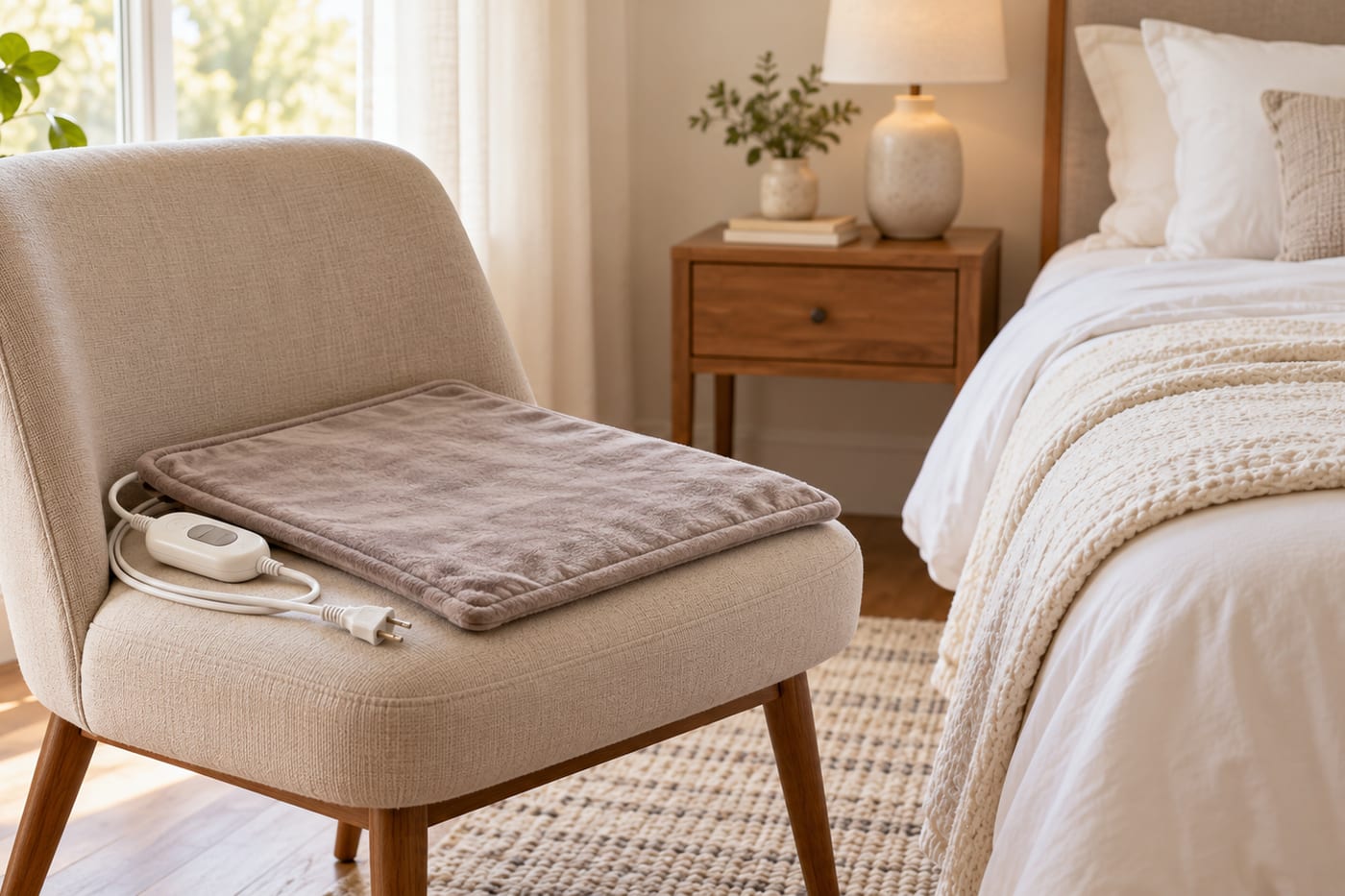
Electric heating pad: a model-specific use demonstration
Paramed demonstrates heat controls, cleaning and cautions for one of its models. This manufacturer video is not medical advice or proof that every pad works the same way; follow the instructions for your own model.
By Paramed · Video language: English
On this article, the player loads when the page opens, without autoplay, unless you chose to block external content. Player privacy information
Open the video on YouTube (in a new tab)
The video illustrates this topic. The full article remains available without watching; captions and transcripts depend on the publisher and YouTube.
What is an electric heating pad?
An electric heating pad is a fabric-covered appliance with a heating element, a power connection and a controller. Products may be flat rectangles, shaped wraps for the shoulders or neck, or designs intended for another body area. The shared name does not imply that all models reach the same temperature, can be cleaned in the same way or are meant to be used on a bed. This guide is about selecting an appliance and using it carefully, not diagnosing pain or recommending medical treatment.
Local warmth may feel pleasant to some people, but it is not suitable in every situation. Before ordering, identify the model's intended user, its warnings and the way it must be positioned. Do not rely on a lifestyle photograph alone. Operating time, controller connection, pad dimensions, cover fabric and cleaning instructions all affect daily use. A clear manual is as useful as a long list of advertised features.
Match the size and shape to the intended area
A flat pad may cover a relatively broad area, while a shaped shoulder model may sit differently around the body. Compare dimensions in centimetres with the place where you intend to put it. Labels such as large or XL are not standard sizes. Check the cord length from the intended chair to a suitable outlet without stretching it or creating a walking hazard. A bedroom photograph does not establish that the appliance is designed to be slept on or placed beneath a person.
Pay attention to instructions about folding, wrapping and pressure. A pad intended to lie flat may not be safe to bend around a joint or sandwich beneath body weight. If it does not sit steadily in the position you need, do not force it into a new shape. Where a manufacturer names a particular body area, treat that statement as a use limit. Compare fit and placement before colour or decorative fabric.
For more information on the subject: A bedroom for better sleep: light, noise and temperature.
Heat controls and automatic shutoff
The number of settings alone does not tell you what temperature reaches the skin. Read the model specification: how is the setting changed, is the controller legible and easy to hold, is the on state obvious, and is there an automatic shutoff? Check the stated time before shutoff and whether that period can be adjusted. When a feature is absent from the documentation, do not infer it from words such as smart or safe on the sales page.
An automatic shutoff does not make it appropriate to sleep with the pad switched on or leave it unattended. The Electrical Safety Foundation International advises against using heating appliances while sleeping or without supervision. A timer is a product feature rather than permission to ignore the manual. Choose controls that let you know whether the device is still heating, and disconnect it after use as instructed by its manufacturer.
Covers, fabrics and cleaning
A soft cover may improve comfort, but distinguish a removable outer cover from the electrical body of the pad. The care label and manual should say exactly which part can be washed, whether the controller must be detached, what cycle is allowed and how completely the parts must dry before reconnection. Do not immerse a connector or controller unless the manufacturer explicitly allows it. A general machine-washable claim is not enough detail for cleaning an electrical product.
Unplug the appliance and let it cool before cleaning. Do not reconnect a cover or pad that remains damp. If the cleaning directions are unclear, request them before purchase. Consider how the fabric feels and how often the cover will need laundering. If frequent washing matters, ask whether a suitable replacement cover is available for that exact model rather than assuming that a cover from another pad will fit.
Inspect the pad before every use
Lay the pad out and look for tears, scorch marks, a new hard lump, exposed wire or a cracked cord. Check that the connector is seated according to the instructions and that furniture is not pressing on the cable. ESFI recommends replacing worn heating pads and blankets, particularly when dark or charred areas or damaged cords appear. Do not tape a damaged wire and keep using the product.
Confirm that plug and outlet match the model instructions and that the area is free from water or spilled drinks. A product with no readable instructions, identifying label or manufacturer information is a poor choice simply because it costs less. If the controller becomes unusually hot, the pad smells burnt or operation is erratic, stop using it, disconnect safely and contact the service provider. Do not open the housing or attempt a home wiring repair.
Use it while awake and check your skin
Start at a setting consistent with the manual and check whether the warmth is comfortable rather than intense. Inspect the skin during use and stop if you notice stinging, pain, colour change or discomfort. There is no single safe operating period for every model and person. Follow the device instructions and do not extend the session merely because the setting is low. Prolonged warmth can harm skin even when a burn does not feel immediate.
Do not sit or lie on a pad that was not designed for that use, wedge it between your body and a mattress, or place blankets and pillows over it. Pressure and covering can trap heat. Avoid folding an operating pad unless that exact design explicitly permits a particular shape. Switch off and disconnect before carrying it to another room; pulling by the cord may damage a connection. Our sleep environment guide discusses room comfort, not leaving a heating device on in bed.
When to seek individual medical advice
If you have reduced ability to feel heat, cold or pain at the intended area, do not rely on noticing overheating quickly enough. NHS heat-therapy information warns against heat on broken skin or an infected area, when temperature sensation is impaired, or when heat increases pain. With a medical condition, during pregnancy, after injury, or when helping a person who cannot communicate discomfort reliably, ask a qualified professional familiar with the situation before use and follow the device restrictions.
This article does not say that heat is appropriate for any diagnosis and does not replace an assessment. New, severe or persistent pain, especially alongside other symptoms, needs professional attention rather than being hidden with warmth. If a burn occurs, stop using the device and consult suitable first-aid guidance or a clinician. Do not put the pad on already injured skin in an attempt to soothe it.
Children, pets and the bedroom
A switched-on heating pad is a hot electrical appliance. Keep it out of young children's reach, and do not leave it with someone who cannot turn it off or report excessive warmth. A pet may lie on it, cover it with fur or chew the cord. Do not improvise a mattress warmer or leave the pad running when you leave the room. A sales photograph showing a bed is not a safety instruction.
If using the appliance while seated in a bedroom, choose a flat position allowed by the model, where you can see the controller and reach the plug. Route the cable away from foot traffic. Never place a running pad inside a bedding-storage box, on a pile of clothes or beneath a comforter. Our bedding storage guide concerns clean, dry textiles; store an electrical appliance only after it is off, unplugged and cool.
What to check before buying in Israel
Look for a complete manufacturer and model name, instructions in a language you understand, importer or service details, electrical ratings suitable for use in Israel, and documentation for any relevant safety testing or marking. A photograph of a certification mark without a traceable model is not enough. Ask for the actual automatic shutoff interval, available heat settings, physical dimensions, cleaning procedure and the contents of the package.
Review the warranty, how a failed controller is handled and whom to contact if the product behaves abnormally. Prices, offers and stock change, so this guide does not claim a current price or link to an unverified product. Compare the label on the delivered item with the listing before use. If a crucial safety detail is missing, request written clarification or select a product with clearer documentation. Purchase links on MyViro currently lead to retailers in Israel only.
Electric versus microwave pads and electric blankets
An electric pad requires an outlet and often allows the user to change heat while it is running. A microwaveable pad operates differently: heating time, filling and manufacturer warnings need their own review. An electric blanket covers a larger body area, so the placement rules for a small pad cannot simply be transferred to it. ESFI warns that different personal heating appliances are not interchangeable or intended for simultaneous use.
The practical choice depends on your environment: whether an outlet is accessible, whether local warmth is wanted for a limited period and whether someone can supervise use. None should be treated as a permanent sleep solution. Compare not only power or the number of modes but also warnings, cleaning, dimensions and how quickly the device can be switched off and unplugged. A separate guide to microwaveable pads will address fillings and reheating instructions.
A final checklist before switching on
Make sure the model suits the intended position, lies as directed and has no visible defect. Check the cord and controller, confirm that the pad is dry, and remove blankets, pillows or other objects that the instructions forbid over it. Read the model-specific operating and shutoff times. Begin only while awake, monitor the skin and stop early if the warmth is uncomfortable. Turn the unit off and unplug it when finished.
After cooling, store the appliance as its manufacturer directs. Avoid sharp folds where prohibited and do not wind the cable tightly around the controller. Keep the instructions where every household user can find them. If there is doubt about a health condition or skin sensation, resolve it before turning the appliance on. A short inspection routine is more valuable than any marketing promise of perfect heat.
What should you compare between electric heating pads?
| Feature | Question to ask | Why it matters |
|---|---|---|
| Size and shape | What are the dimensions in centimetres and intended body area? | Suitable coverage without improvised folds |
| Controller and shutoff | How is heat changed and when does operation stop? | Clear operation without treating a timer as permission to sleep |
| Cover and cleaning | Which part can be cleaned and how must it dry? | Keeping electrical components dry |
| Cord and service | How long is the cord and who handles a fault? | Convenient placement and safe response to damage |
Frequently asked questions
Can I sleep with an electric heating pad switched on?
No. ESFI advises against using heating appliances during sleep or leaving them unattended, even when a model has automatic shutoff.
Does automatic shutoff make unattended use safe?
No. Verify the feature in the model specification, but continue to use the device while awake and in accordance with its instructions.
Can I fold a heating pad around my body?
Only if the exact model instructions explicitly allow that position. Unplanned folding or pressure can trap heat and damage the appliance.
Can an electric heating pad be washed?
Check which parts are washable and follow the instructions for disconnecting and drying them. A removable cover does not mean the electrical body can be immersed.
When should I seek advice before using heat?
If heat sensation is reduced, skin is broken, warmth increases pain, or a health condition or injury could alter the risks.
What if the cord is damaged or there is a burnt smell?
Stop use, disconnect safely and contact service or replace the product as directed. Do not improvise a home wiring repair.
Sources and scope
Sources checked on 22 October 2026. Model details apply only to the specified product; the measurement and storage suggestions are practical guidance, not the result of our own product tests.
- Electrical Safety Foundation International: Heating Pads and Electric Blankets Safety
Cord and fabric inspection, avoiding covers and folds, and avoiding use during sleep or without supervision.
- CPSC: JKMAX Heated Blankets and Heating Pads Recall, September 2026
Documented overheating risk and the value of exact model identification and recall awareness; not a claim against every brand.
- University Hospitals Coventry and Warwickshire NHS: Heat and cold therapy
Conditions requiring care with heat, including broken skin and reduced temperature sensation; not instructions for a particular electrical device.
- NHS: Burns and scalds
General first-aid context for a burn; not a substitute for individual medical advice.
By MyViro.
The content explains textile characteristics and is not the result of a product test in a laboratory. How we prepare our guides
Illustrative photos on this page were created with AI.