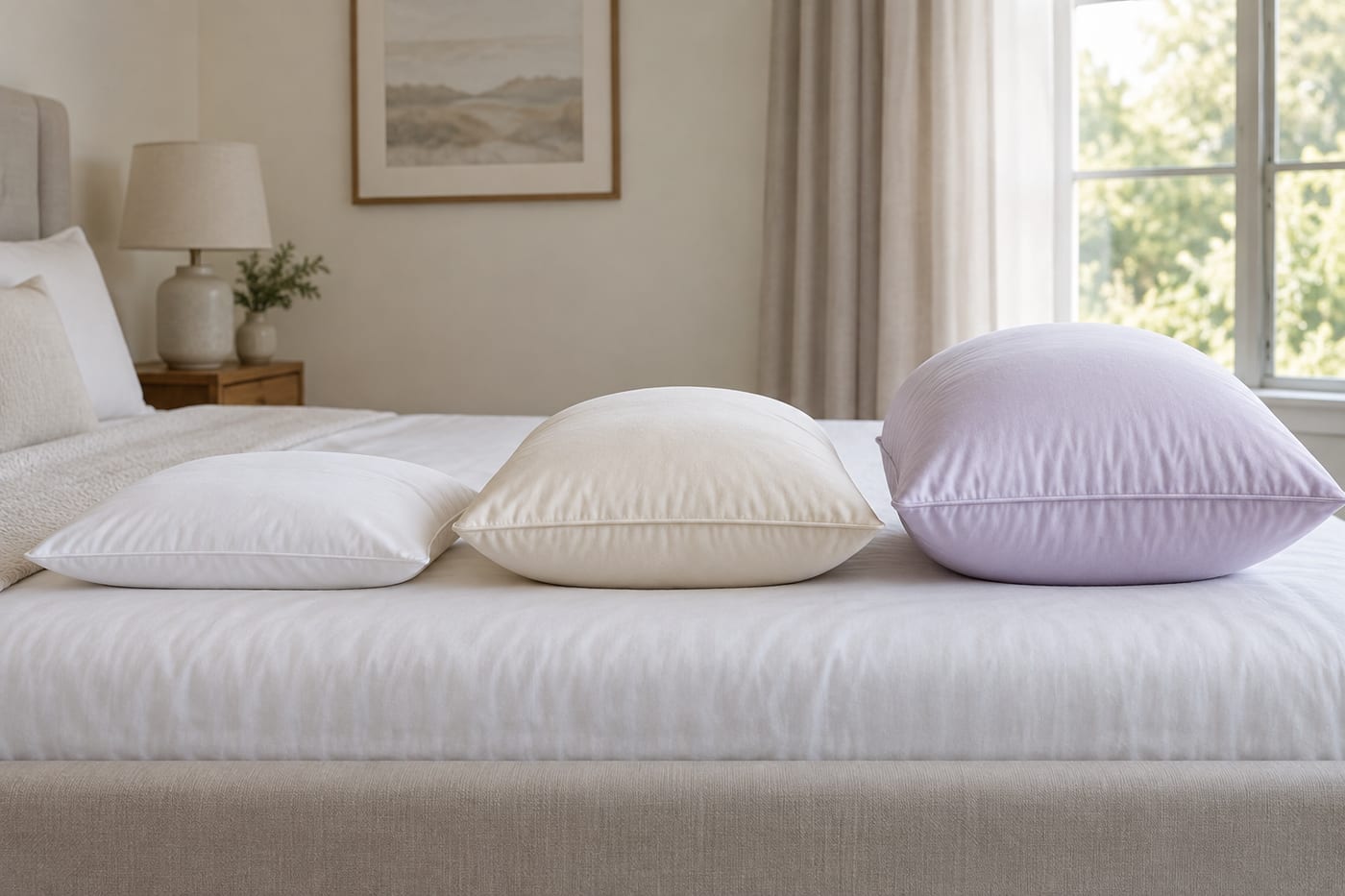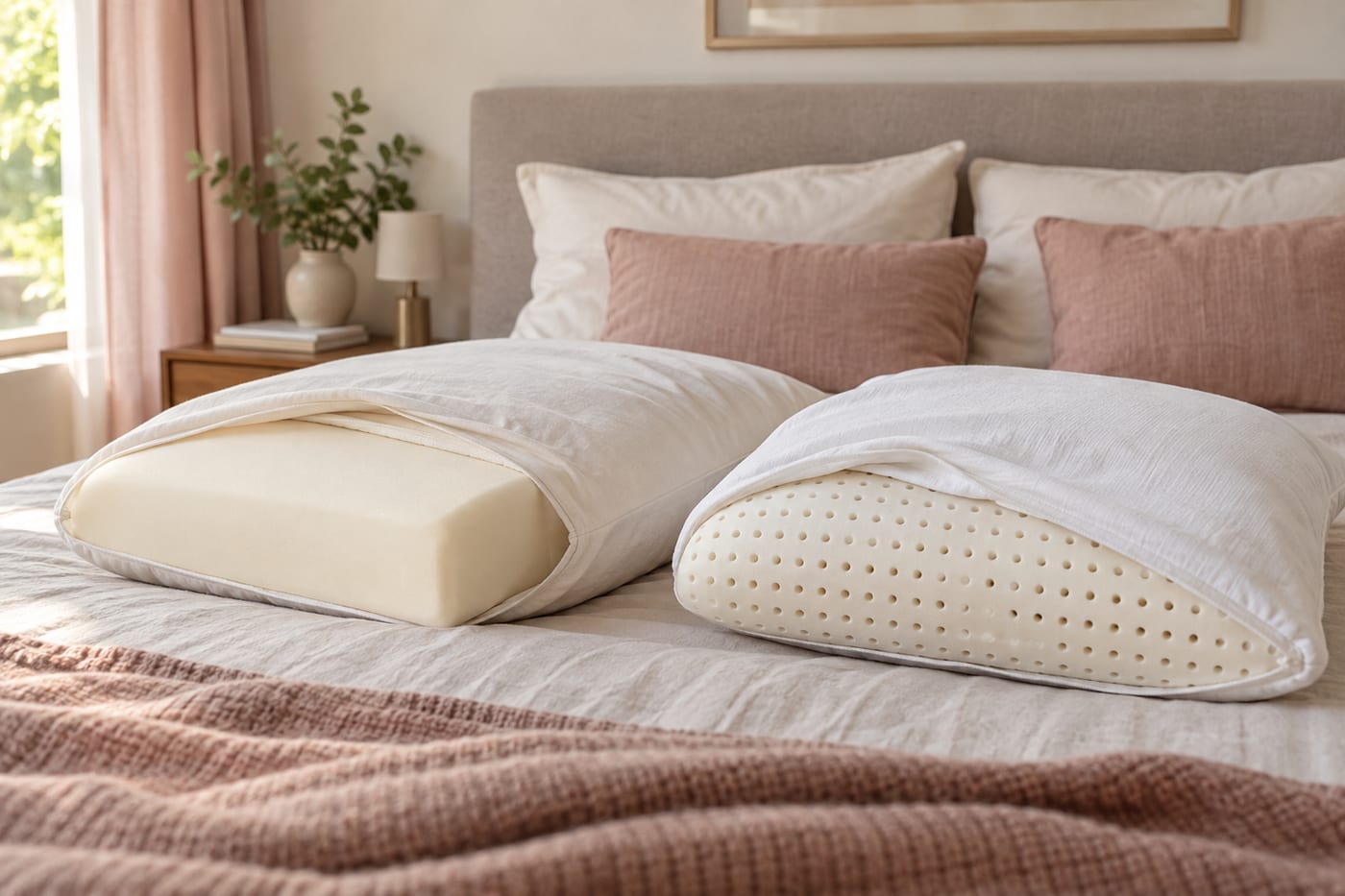
Memory foam and latex are material families, not complete specifications
A shop’s question of memory foam or latex can make the decision seem to depend on just two words. Each family actually includes models with different structures and feels. Visco is a common name for viscoelastic memory foam, usually within the polyurethane-foam family. Latex foam may be based on natural rubber, synthetic material or a blend, depending on the model’s composition. The material name does not establish pillow height, how far it compresses or whether filling can be removed.
For a practical comparison, record four details for each model: core or filling type, dimensions and height, adjustment options and care instructions. Check whether a term such as bamboo describes only the cover; it does not necessarily identify the core. If a retailer presents an orthopaedic label without a specification, request information about the actual product. Our general pillow-selection guide covers broader uses and sizing, while this comparison concentrates on the two foam families and how to evaluate models within them.
How memory foam feels and what slower recovery means
Memory foam characteristically recovers relatively slowly after compression. Press a suitable core and release it, and the impression may remain briefly before the material returns. When lying down, this can feel like gradual contouring with less immediate spring back. The strength and speed of that sensation vary with formulation, construction and use conditions. There is no requirement for every memory-foam pillow to retain an identical handprint, and no universal number of seconds establishes its membership of the material family.
For someone who enjoys the feel, a potential advantage is a surface that adapts gradually without a strong elastic response. A potential trade-off is that changing position may feel less immediate, or the pillow may feel different after time lying down than during a brief hand press in a shop. Try lifting your head and placing it on another area as well. Observe the actual product instead of assuming the name means it is always soft, always firm or necessarily suited to your sleeping position. Recovery is a feature to compare, rather than a general quality ranking.
For more information on the subject: How to choose a pillow: height, filling and sleep position.
Memory foam versus latex: what to compare in the model
| Question | Memory-foam pillow | Latex pillow |
|---|---|---|
| Recovery after pressure | Usually slower recovery and gradual contouring | Usually faster recovery and an elastic response |
| Construction | Solid core or shredded fill; blends are possible | Solid core or shredded fill; blends are possible |
| Height adjustment | Only in models designed for adjustment | Only in models designed for adjustment |
| Height while lying down | Depends on compression, fill quantity and mattress | Depends on compression, fill quantity and mattress |
| Material composition | Usually memory foam within the polyurethane family | Natural, synthetic or blended according to the model |
| Washing | Distinguish cover from core; follow the model label | Distinguish cover from core; follow the model label |
| Temperature sensation | Evaluate the system and model; gel is not a guarantee | Evaluate the system and model; holes are not a guarantee |
| Before purchase | Try lying down; check specification and service terms | Try lying down; check specification and service terms |
How latex feels and whether it is always natural
Latex foam tends to offer a faster elastic response: compress it, release it and it returns relatively quickly. In a solid pillow, this can feel like a surface that yields beneath the head while continuing to push back. Some people prefer that response when changing position, while others find it too springy. Firmness, core thickness, manufacturing process and cover also influence the feel. A latex pillow need not be tall or firm, and a soft model can still recover quickly.
The word latex does not guarantee 100% natural rubber. Look for an explicit composition statement and identify the component it describes. Talalay and Dunlop name manufacturing processes; they do not by themselves establish that the complete material is natural or organic. Talalay Global describes natural formulations and blends within the Talalay process. If origin matters to you, request model-specific information and a relevant certificate instead of relying on a category-page logo. A natural-content statement alone cannot establish personal fit or predict the sensation you will prefer.
Solid core or shredded fill: sometimes the bigger difference
A solid-core pillow is a continuous piece, sometimes rectangular and sometimes contoured with a central dip or differing heights. Its structure is predetermined, so you generally cannot remove a handful to lower it. A shredded pillow contains foam pieces inside a casing, sometimes blended with fibres. Either memory foam or latex can be used in both constructions. Comparing shredded memory foam with solid latex therefore examines more than material: it compares two different ways of maintaining a pillow’s shape.
Pieces can move and redistribute within their casing, and the sensation depends on their quantity and freedom to move. Some models have an opening for adjusting filling; others do not. A zip on the outer cover is not necessarily access to the fill. Check which parts may be opened and how to redistribute material. Sleep On Latex offers both a core pillow and a shredded model, while Coop presents a memory-foam model with adjustable filling. These examples show why construction belongs beside material in the specification, without implying that every shredded pillow can be adjusted.
Unloaded height versus height beneath your head
The height in a specification is measured by the manufacturer’s method and does not necessarily describe the pillow carrying the weight of your head. Two pillows with similar external heights can remain at different heights when used. A softer core may compress differently from a firmer one, while shredded filling may move towards the edges. A stated height is therefore no substitute for trying the item on a bed. No single centimetre chart can settle the choice between memory foam and latex in every situation.
Consider the mattress, topper and how your shoulder and body settle into them. Changing one of these can make a familiar pillow feel different even when the pillow itself has not changed. Check whether your head rests comfortably without needing to fold the pillow or add a permanent extra layer beneath it. Another person’s observation may help, but a photograph is not a diagnosis. Persistent pain or a medical issue requires appropriate advice; choosing a pillow material is not a substitute. This comparison addresses fit and comfort rather than treatment.
Softness, firmness and density are separate questions
Soft and firm describe feel rather than one standard scale shared by all shops. A pillow may feel soft initially but remain tall and full after lying down, or behave the other way around. Material density, where supplied, is not by itself a measure of the finished item’s firmness. Thickness, geometry and casing also affect response. Do not use pillow weight or price to guess how it will hold your head. Request model-specific explanation and try it rather than comparing firmness labels alone.
A hand press helps reveal response, but is brief and different from lying down. Allow enough time to notice whether the head continues to settle, edges become intrusive or you want to move the filling. Do not forcefully bend a shaped core to make it softer; some manufacturers restrict folding. When pillows feel different, record the experienced difference: height in use, response, shape or cover sensation. That description helps select a useful next model to compare more than a conclusion that every pillow made from a particular material is unsuitable.
Contoured or rectangular: check orientation and both sides
A contoured pillow may have two heights, a central recess or a raised edge. Either memory foam or latex can form that shape, so contouring is not exclusive to one family. Before trying it, check the manufacturer’s intended orientation and whether its sides differ. An overhead product photograph may conceal a substantial raised edge. For someone who prefers using the full pillow surface, an even rectangular shape can feel different from a structure directing the head towards a particular area.
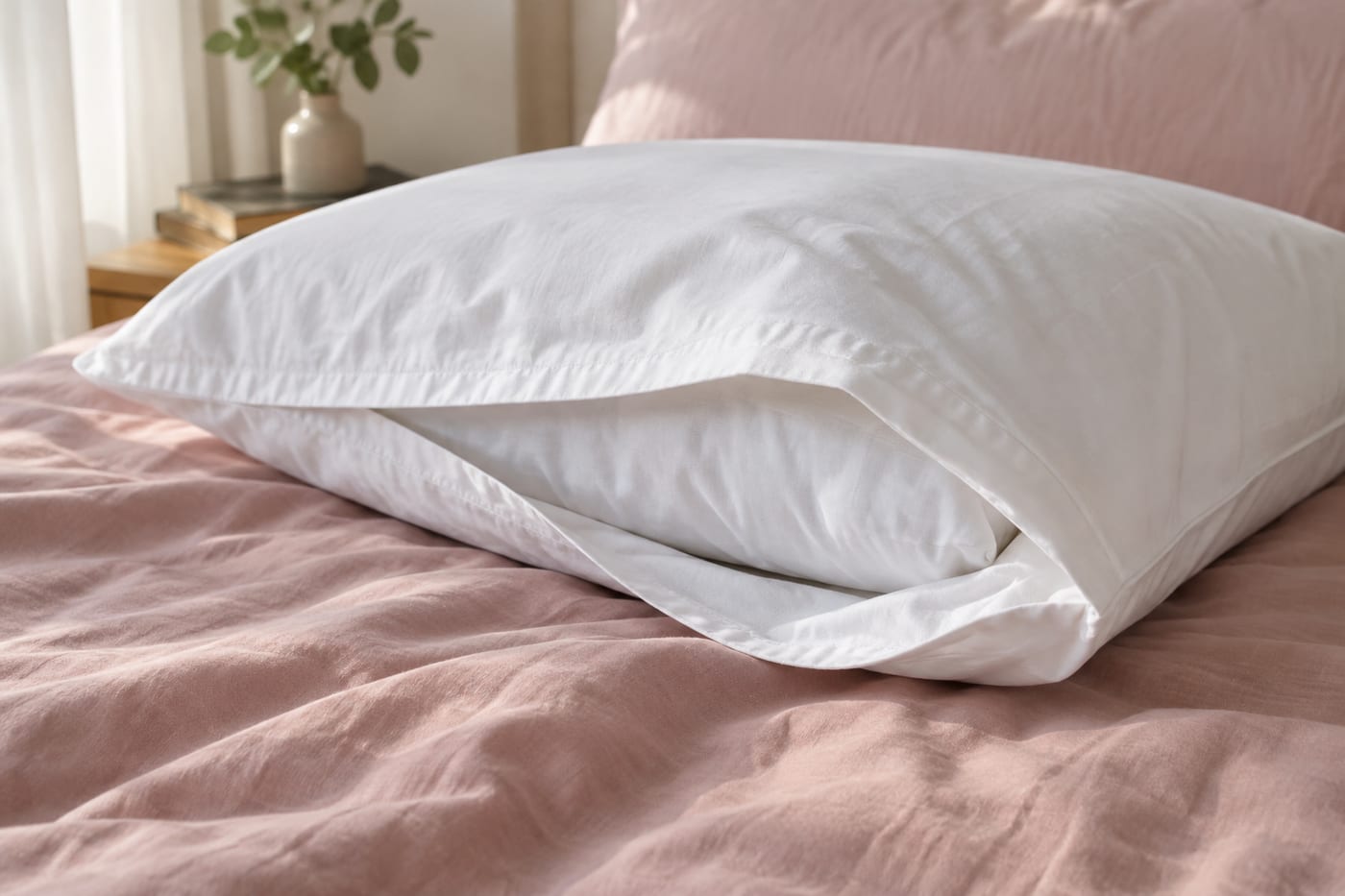
Check whether your pillowcase suits the shape and dimensions. An overly tight cover may restrict casing movement, while a large fold can be noticeable beside the face. Do not stretch a small pillowcase around a core simply to keep using a matching bedding set. Request product and replacement-cover dimensions before buying, and establish whether the cover can be removed for cleaning without disturbing the shape. An orthopaedic description is not in itself proof of medical benefit or universal success. The design’s practical value depends on your fit with the actual model.
Changing position: evaluate response instead of guessing
If you move between side and back sleeping, try both positions during comparison in a shop or an authorised home trial. Notice whether transitions require rearranging fill, whether a solid core recovers comfortably and whether a contoured edge obstructs movement. Faster latex response may suit one preference and gradual memory-foam contouring another. It does not follow that everyone who moves frequently must choose a particular material, since construction and height influence transitions too. Use your familiar positions rather than a pose chosen to match a product photograph.
With an adjustable shredded model, make small changes as directed and store removed filling in a clean, closed container. Reassess after adjustment, and do not add material from another product without permission. Removing filling may lower the pillow while also changing distribution and feel, rather than merely altering a height number. If every position requires a substantial fold or constant pushing of material, compare a more suitable structure. The aim is a repeatable, comfortable routine instead of an arrangement that requires a struggle at every change of position.
Heat, ventilation holes and gel: reading cooling claims
Temperature sensation involves a complete system: core, filling, cover, protector, pillowcase and room conditions. Holes in a latex core, shredded memory foam or added gel describe design details, but cannot guarantee comfort throughout the night. An initially cool touch is not necessarily the sensation after prolonged use. When a product page promises cooling, check exactly what was tested, under which conditions and which pillow component the claim describes. A commercial name in the heading does not supply those answers.
Compare models with a similar pillowcase and the protector you will actually use when trial rules permit it. Record changes during use and what happens after moving to another side. There is no rule that every latex pillow feels cool or every memory-foam pillow feels hot, and a warm Israeli summer room does not automatically make gel necessary. If temperature comfort is especially important to you, cover-construction details and clear trial conditions may be more useful than a cooling slogan. Room conditions and other bedding remain part of the evaluation.
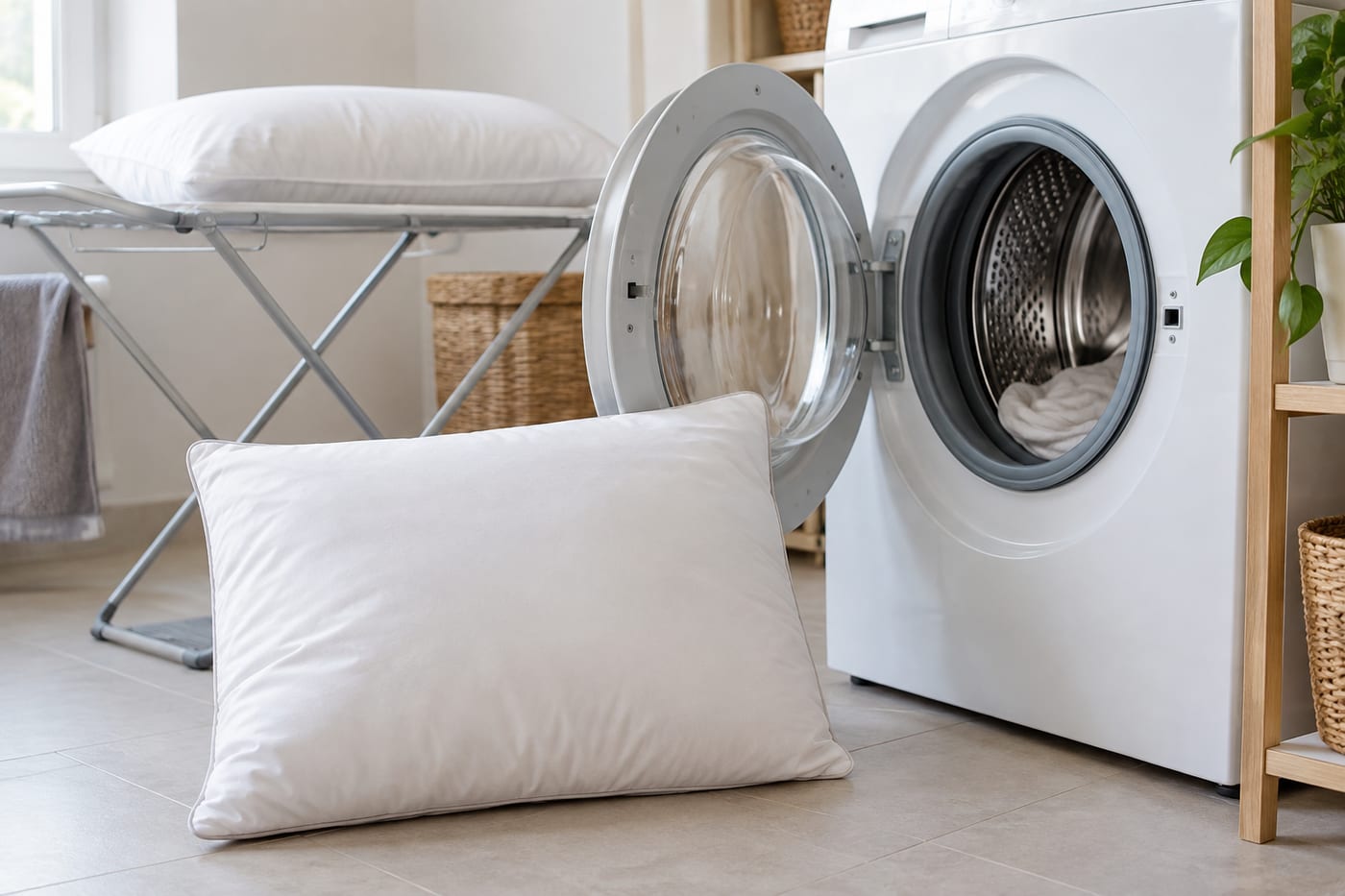
Washing and maintenance: separate the core from the cover
Check separately whether the core or filling can be washed and whether permission applies only to a removable cover. Memory foam does not mean washable, and latex does not establish easier cleaning. For example, TEMPUR publishes restrictions on wetting the core material in many of its products, while Coop specifies washing for the pillow and cover of a particular Original model. This variation within one material family illustrates why model instructions matter. Do not transfer an approved shredded pillow’s washing cycle to a different solid core.
A removable cover may make regular care easier, but has its own label and drying limits. Check availability of a correctly sized replacement and whether an inner layer must remain in place. Use a compatible protector and pillowcase that suit both the product and your preferred feel, and plan how you would handle a spill. Our pillow-washing guide explains how to read the care directions. Do not wet a core to refresh it when the manufacturer prohibits that, and do not assume a dry cover establishes dry filling after an approved cleaning process.
Odour, composition and sensitivity: ask about the model
A new item may have a noticeable smell, but smell alone cannot identify natural content, quality or suitability. Check the model’s unpacking and airing instructions, including any required wait before use. Do not try masking odour with fragrance, steaming or wetting when the pillow’s directions do not allow it. If smell accompanies irritation or a reaction, stop using the item and seek appropriate medical and manufacturer advice. Odour preference is part of comfort, not a laboratory assessment of the material.
Hypoallergenic wording also does not establish that an individual cannot react. Natural rubber may matter to someone with known latex sensitivity, and a fabric cover should not be assumed to resolve that question. The FDA explains that proteins in natural rubber latex can trigger reactions in sensitive people; that medical source does not assess the pillow models in this guide. For known or suspected sensitivity, establish composition with the manufacturer and obtain suitable medical advice. A material or emissions certificate is not a guarantee against an individual allergy.
Durability, warranty and trials: checks before paying
No single lifespan separates every memory-foam pillow from every latex pillow. Manufacturing quality, construction, use and care all contribute, and a warranty is not necessarily a promise that the pillow will feel identical throughout the covered period. Read what qualifies as a defect and what is treated as a change in feel or preference. Check conditions governing unpacking, washing, fill adjustment and return of a used product. Do not assume an Israeli retailer offers the trial terms shown on a foreign manufacturer’s website.
Ask about replacement covers, care information and service for a tear or filling change. A more expensive pillow that cannot be maintained in a way suitable for your household is not automatically a more useful purchase. During a trial, retain packaging and labels where return conditions require them, and briefly record the feel in your normal positions. If it changes, check model-specific redistribution or settling directions before deciding. Clear terms and a full specification help with a decision, but cannot replace personal experience or make one material the winner for everyone.
Summarise the comparison and choose two models to try
Instead of concluding that memory foam or latex is better, make a short list of your requirements. You might want a feel without rapid push back, adjustable height and a removable cover; or immediate response, a continuous core and a rectangular shape. Find two models meeting those requirements and compare them under similar conditions. You may discover the preference comes from height or construction rather than material. Another model within the same family can also feel very different from the first one you tried.
For each model, record what happens while lying down, during a position change and which care tasks are permitted at home. Confirm pillowcase fit, trial terms and dimensions before paying. If you share a bed, both people need not use identical pillows to preserve a coordinated appearance; suitably sized matching pillowcases can hold different models. The practical choice combines a response and height you find comfortable, construction suited to your use and care directions you can follow. The material label helps frame the questions, while the specification and experience complete the decision.
Compare the whole pillow

- Identify material and structure
- Check height and feel
- Check care and fit
Video: memory foam versus latex pillows
Mattress Clarity briefly compares memory foam and latex pillows. The illustrated differences are a starting point; the actual model’s height, firmness and structure affect feel and personal fit.
By Mattress Clarity · Video language: English
The player loads only after a click, subject to your external-content preferences. Player privacy information.
The article can be read without watching. Captions depend on the options available on YouTube; the explanation is not a transcript.
Frequently asked questions
What is the main difference between memory foam and latex pillows?
Memory foam tends to contour and recover more slowly after pressure, while latex tends to respond and recover faster. A complete model’s feel also depends on construction, height, firmness and cover.
Is a latex pillow always natural?
No. Natural, synthetic and blended compositions exist. Talalay and Dunlop names alone do not establish composition; request the model’s specification.
Is a shredded pillow always adjustable?
No. Adding or removing fill is permitted only where the manufacturer describes the model as adjustable. An outer-cover zip is not necessarily access to the fill.
Which material is better for side sleeping?
Material alone cannot decide. Check height beneath your head, response and mattress compatibility in your normal position. Models within one family can fit differently.
Is latex always cooler than memory foam?
That cannot be guaranteed for every model. Core, cover, protector, pillowcase and room conditions all contribute, and an initially cool touch does not test a complete night.
Can a memory-foam or latex pillow be washed?
Check the specific model and separate core from cover instructions. Some cores have substantial restrictions and there are approved exceptions; do not generalise from the material family.
Does an orthopaedic description guarantee relief from neck pain?
No. A product heading is not a medical guarantee and does not replace personal fit or assessment of persistent pain. This guide compares comfort, construction and maintenance.
Can I use latex if I have known sensitivity?
Do not infer suitability from hypoallergenic wording or a fabric cover. Confirm composition with the manufacturer and obtain medical advice appropriate to your sensitivity.
Sources and scope
Sources checked on 10 October 2026. Manufacturer sources describe their own products and instructions; they do not establish one care rule for all bedding and mattresses.
- Polyurethane Foam Association: foam applications
Primary industry information describing viscoelastic foam as slow to recover after compression; not a medical assessment of pillows.
- Talalay Global: Talalay process and composition
Manufacturer information on elastic response and natural or blended formulations. Broad marketing statements are not used here as performance guarantees.
- Sleep On Latex: natural latex core pillow
An example of a latex core, removable cover and rapid recovery in a particular model.
- Sleep On Latex: product constructions
Manufacturer listing core and shredded latex pillows as separate products; material name alone does not determine construction.
- Coop Sleep Goods: Original Adjustable Pillow
An example of adjustable memory-foam and fibre filling; a model specification, not a description of every memory-foam pillow.
- Coop Sleep Goods: care instructions
Separate care instructions for the Original outer cover and inner pillow, including model-specific washing permission. These do not apply to every memory-foam pillow.
- TEMPUR: product cleaning and care
An example of restrictions on wetting the core and separate cover directions; check product version and manufacturer exceptions.
- FDA: natural rubber latex and sensitivity
Primary medical information on natural-latex proteins and ingredient enquiries where sensitivity exists. It does not test pillow safety or recommend a model.
By MyViro.
The content explains textile characteristics and is not the result of a product test in a laboratory. How we prepare our guides