Jewish split bed: opening storage and separating the bases
Alina demonstrates how one commercial model opens its storage box and separates its two bases. It illustrates the checks in this guide but does not show that every model uses the same mechanism.
By Alina — sleep solutions for the religious community · Video language: Hebrew
On this article, the player loads when the page opens, without autoplay, unless you chose to block external content. Player privacy information
Open the video on YouTube (in a new tab)
The video illustrates this topic. The full article remains available without watching; captions and transcripts depend on the publisher and YouTube.
What makes a Jewish split storage bed different?
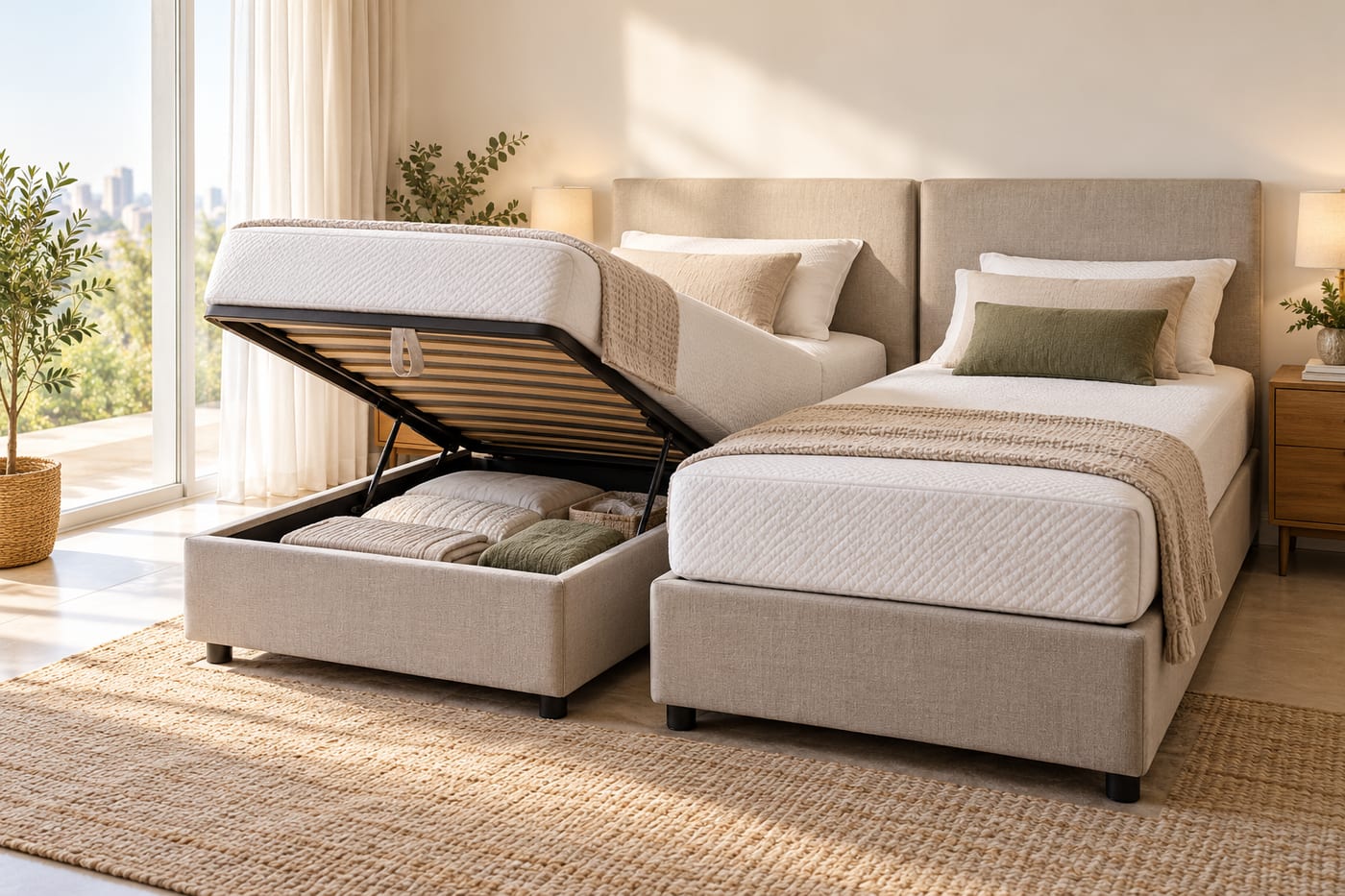
A Jewish split bed usually has two sleeping units that can be pushed together or separated. Add under-bed storage and a second set of questions appears: is there a compartment beneath each side, and can both be opened when the units are together as well as when they are apart? The retail name alone does not guarantee two compartments, two lifting mechanisms or complete separation of the frames. King Imperial describes its Sarah model as two independent bases with their own lifts. Shomrat Hazorea describes a Bereshit model whose headboard stays attached to one unit while the other separates. These are model examples, not universal rules.
Start with the household's actual routine: how often the beds move, who needs access to storage and how much passage space is needed when the units are apart. This guide addresses frames, connections and compartments. For sheets and duvet covers, see our bedding size chart. A styled photograph of matching bed linen does not specify the underlying frame.
Two kinds of dimensions: mattress and frame
A product page might call a bed 160 × 200 cm, but you still need the size of each mattress and the footprint of the surrounding frame. King Imperial lists two 80 × 200 cm mattresses for Sarah, a 160 × 200 cm combined sleeping area and outside dimensions of 172 × 220 cm. Shomrat Hazorea lists two 80 × 190 cm mattresses and a 168 × 209 cm outside frame for its Bereshit model. These two examples show why a label such as “160 cm Jewish bed” cannot tell you either the full length or the floor space needed.
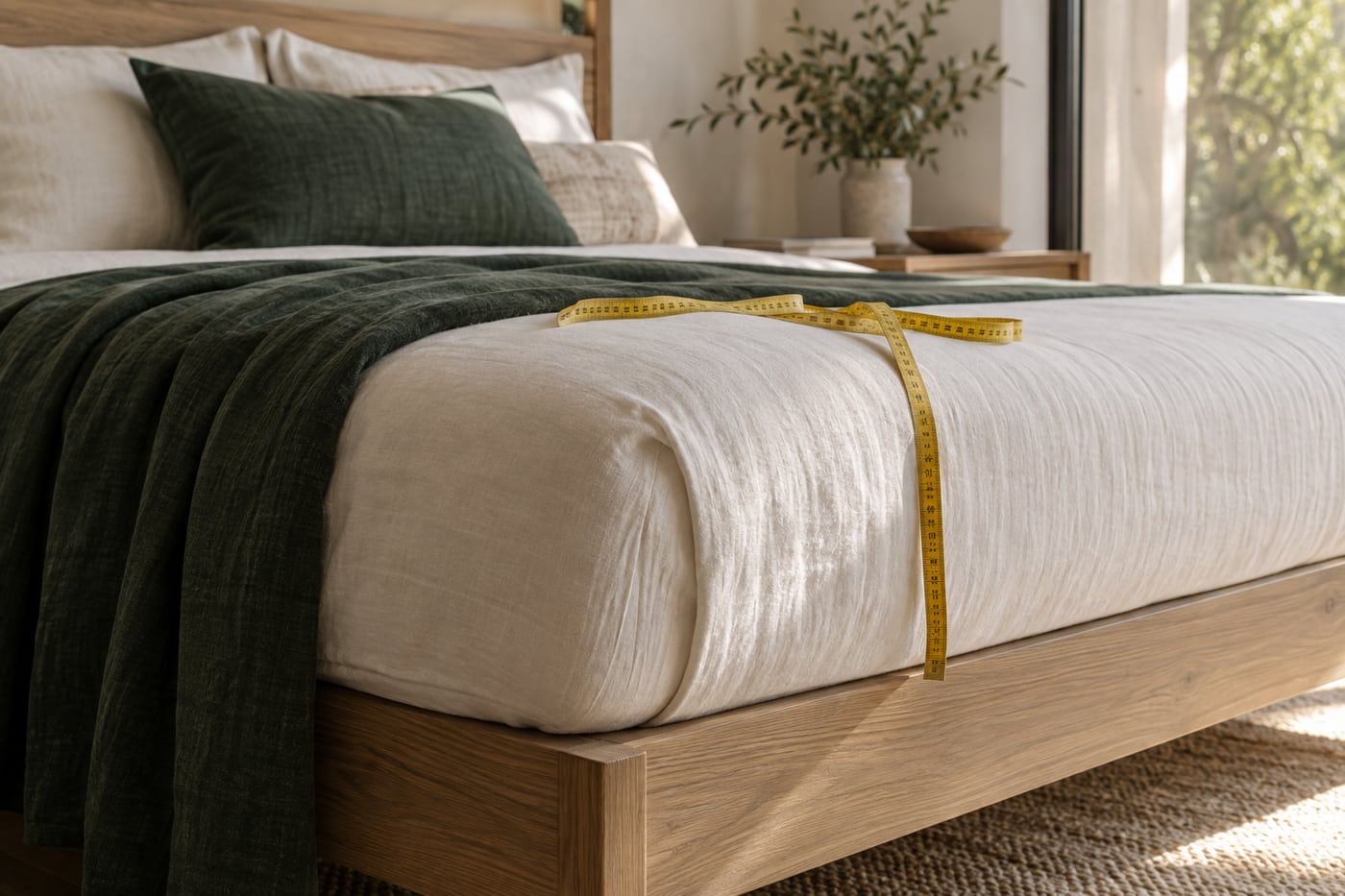
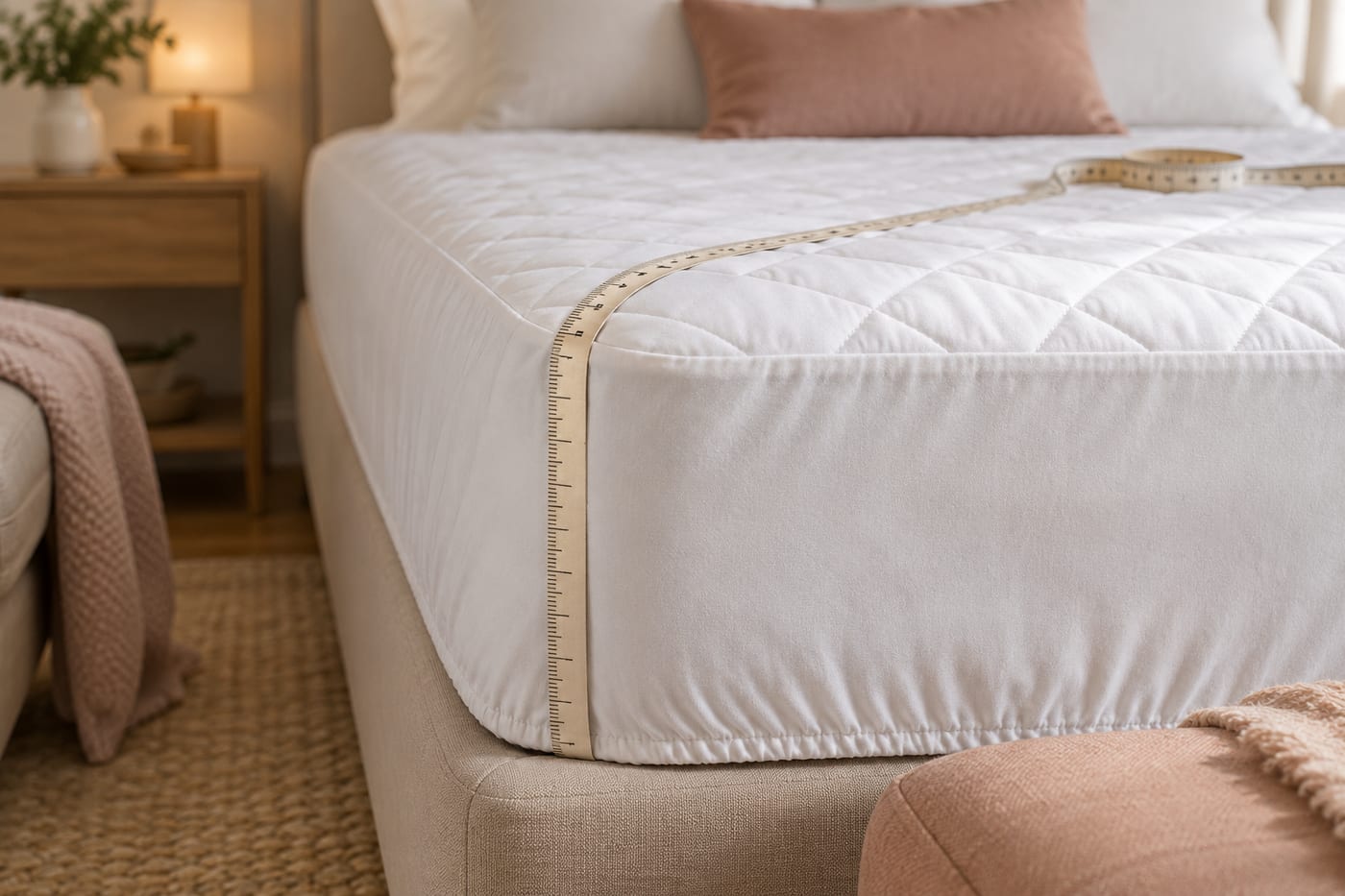
Write down three sets of figures separately: each mattress's width and length, each base's width and length, and the overall size when connected. Add the projection of the headboard if it stands proud of the frame. A fitted sheet is bought for a mattress, not the outer frame. A mattress protector also needs each mattress's depth checked.
For more information on the subject: Double Bed with Storage: Sizes, Lift Mechanisms and Drawers.
Plan the room in both positions
Sketch the bedroom with the outside dimensions of both bases, bedside tables, wardrobe and door. Mark two layouts: beds together and beds apart by the distance you really intend to use. A gap in a catalogue photo is not a measurement. Check that a person can reach each bed, a wardrobe door can open and the storage handle can be reached without shifting furniture. If one unit moves, identify the direction it can travel and whether a thick rug, uneven floor or cable sits in its route.
A shared-looking headboard can keep the bedroom visually coherent when the beds touch, but you need to know whether it fixes to a wall, one bed or both. Shomrat Hazorea says the fixed side of its Bereshit headboard can be selected at assembly. If you may reverse the direction later, ask whether the chosen model permits it and what work is involved. A room plan in both positions is more useful than choosing by the mattress width alone.
How do the two storage compartments open?
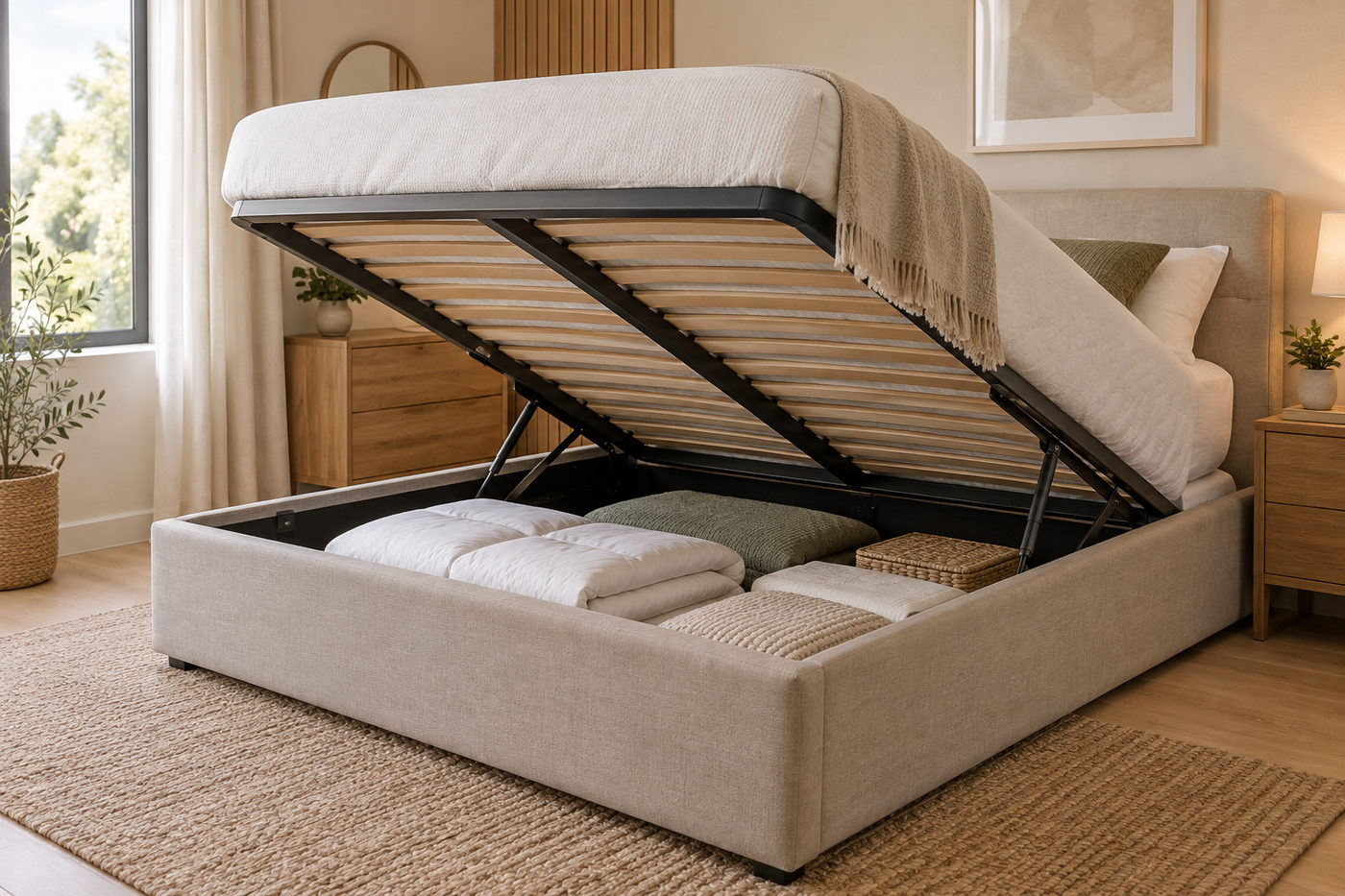
Some two-base models provide a separate lift for each side; verify this on the particular product page. In King Imperial's Sarah example each compartment opens independently. Another design may use a shared connection, a drawer or a different opening direction. Ask for a clear image or demonstration of opening and closing the beds when touching. Confirm that one side can be accessed without moving the other. Identify the grip position and the path travelled by the platform. A bedside cabinet beside the handle or a low shelf overhead can make a large compartment awkward to use.
If the frame has gas struts or another lift, request its instructions and any stated mattress-weight limit. Do not transfer a weight limit from a regular double bed or another model. After assembly, ask for a full opening and closing demonstration with the intended mattresses in place. Check that fabric does not get caught and the platform closes evenly. A damaged moving part should be addressed by the model's service provider rather than dismantled at home.
Clips, feet and moving the beds
A bed can look split in a photograph but still be inconvenient to separate frequently. Ask whether a clip or connector joins the bases, how it is released and whether it remains reachable when the compartments hold bedding. Shomrat Hazorea describes an easy-to-remove connector on its Bereshit model. That is a property of one design, not a promise about all split beds. Check what contacts the floor and whether cleaning beneath each unit is practical. Consider floor protectors if the maker recommends them for your surface.
Request a demonstration of moving the units with their mattresses fitted, ideally in conditions similar to your room. If a retailer mentions castors, locks or catches, ask for details and care instructions. A tall carpet pile or uneven floor can change how easily a unit moves. Do not assume the units will stay aligned simply because they are heavy. Confirm the intended connection in the joined position and the stability of each base when separate.
One headboard or two?
Some split beds use one headboard that remains with a fixed unit. Others have two separate heads, or a single-looking headboard connected in another way. This changes the appearance when separated and the amount of wall space the arrangement needs. In Shomrat Hazorea's Bereshit description, the headboard remains with one side and the other can move away. Another design may leave both bases beneath a wider fixed headboard. Ask exactly what is supplied and which parts are joined during assembly.
If the beds are separated daily, view the sides and back in that position, not just a front photograph with both sides together. Make sure there is no projecting unfinished edge along the movement path and that both compartments remain accessible. The visual design matters, but so do headboard height, nearby power outlets and bedside-table access. Compare the precise construction rather than only the upholstery colour.
How much useful storage is there?
Two compartments are not automatically equivalent to one undivided double-width box. Sidewalls, lifting struts and dividers take up room. Ask for the usable inside length, width and depth of each compartment. Compare those numbers with the largest thing you want to store after folding, perhaps a winter duvet or spare pillow. Ask whether the maker states a contents-weight limit, whether the floor of the box is raised and how the corners can be cleaned. A photograph of an empty box cannot establish its usable capacity.
Two boxes may make it easier to separate each person's linen and open only the relevant side. Conversely, a large double duvet may not fit easily in either individual box. Measure it folded and consider the opening, not just the internal footprint. Our bedding storage guide covers preparing fully dry textiles and arranging them so a complete set is easy to find without unpacking everything.
Ventilation, cleaning and safe operation
An under-mattress compartment should remain dry and inspectable. Do not pack away bedding that has not dried completely. US Environmental Protection Agency guidance on indoor moisture advises addressing water sources and avoiding the enclosure of damp materials. Check the compartment periodically for smell, marks or dampness. If you find a problem, remove the contents, find its cause and follow the bed's and textile's care instructions. Perfume or a sealed bag will not resolve persistent moisture.
While raising and lowering a base, keep hands, children and pets away from moving parts and follow the manufacturer's warnings. Do not store anything that can catch in a hinge or prevent complete closure. Stop using a lift that moves unevenly, will not remain stable or makes an unusual noise, and contact service. If high feet are advertised, check how you would clean beneath both bases when the beds are joined. One model's foot height does not establish access for another.
What is included in the order?
“Split bed with storage” may refer to a frame and two boxes, while mattresses, headboard, delivery and assembly may be separate options. Shomrat Hazorea's Bereshit listing describes purchase with or without matching mattresses. Before ordering, request a written contents list: two bases, a box and mechanism for each side, connectors, headboard, feet, mattresses and assembly. Find out what the warranty covers and who services a failed lifting mechanism. A photograph showing dressed mattresses is not proof that they are included.
For an online purchase, ask for a dimensions diagram of the precise version and finish chosen, rather than only an inspiration image. Check how the parts reach the room through the entrance, lift and corridor, and who is responsible for final assembly. Delivery and return terms can change, so read them directly before paying. This article reports no current price or availability and is not a hands-on product review.
Split storage bed versus a regular double bed
A conventional double bed may have one large box beneath a single lifting base. A Jewish split storage bed may let each side function independently, but it brings more connections and measurements to inspect. Neither arrangement is best for every household. Someone who never separates the beds may prefer the simplicity of one base. A household that uses independent sides needs to confirm that opening storage never requires moving the whole arrangement. Our double storage bed guide compares lift-up platforms and drawers more broadly.
The two mattresses do not necessarily have to feel identical, but their sizes, surface heights and base compatibility must follow the bed maker's instructions. If each side receives a different mattress, check the specific mechanism's suitability for its weight and whether the units join as intended. Never treat the “combined sleeping size” as a complete specification for either mattress. A single fitted sheet for a regular double bed is unlikely to suit two sides that move apart.
A practical checklist before deciding
Before buying, record each mattress size, each base size, the joined outside footprint, the desired separation distance and the room dimensions. Add the number of boxes and lifts, opening direction, usable inside dimensions and any stated load limits. Note how the headboard attaches, which side moves, how the connector is released and refitted, and whether a cabinet, wardrobe or door blocks access. Ask the retailer to confirm these facts in writing for the exact model and configuration.
Once the frame is chosen, select a fitted sheet and protector for each mattress by actual width, length and depth. The duvet and its cover have their own dimensions. Our single-bed bedding guide explains the separate pieces, while the size chart is a starting point. Working in this order helps avoid a frame that fits the room but leaves one box inaccessible, or linen ordered to fit the outside frame instead of the two mattresses. Current purchase links on this site, where present, lead to stores in Israel only.
What should you check on a split storage bed?
| Feature | Beds together | Beds apart |
|---|---|---|
| Two bases | Overall outside dimensions and joining clip | Required gap and access around each side |
| Two boxes | Whether either side opens alone | Opening direction and clear route |
| Headboard | Which base it attaches to | Appearance and location of the moving unit |
| Mattresses | Each mattress size separately | A sheet and protector for each side |
Frequently asked questions
Is a 160 × 200 cm split bed only 160 cm wide in the room?
Not necessarily. That may describe two 80 × 200 cm mattresses together; the outside frame can be wider and longer.
Does every Jewish split bed have two storage boxes?
No. Check the exact number of compartments and mechanisms and whether each side can be opened independently.
Can one box open while the beds touch?
Some models allow it, but verify the opening direction and ensure the headboard or bedside tables do not block access.
Which side remains attached to the headboard?
Read the connection specification and request a demonstration. Some models let you choose the fixed side at assembly.
Which sheet fits a Jewish split bed?
Measure each mattress separately, including its depth, and choose a fitted sheet stated to fit that mattress and pocket depth.
What should be confirmed before ordering?
Confirm frame and box dimensions, separation and opening method, package contents, assembly, warranty and model-specific operating instructions.
Sources and scope
Sources checked on 21 October 2026. Model details apply only to the specified product; the measurement and storage suggestions are practical guidance, not the result of our own product tests.
- King Imperial: Sarah Jewish split storage bed
Model example with two 80 × 200 cm bases, 172 × 220 cm outside dimensions and two independent lifts.
- Shomrat Hazorea: Bereshit split bed
Model example with a selected fixed headboard side, two 80 × 190 cm mattresses and 168 × 209 cm outside frame. Listed as out of stock at review; not a purchase recommendation.
- Dr Gav: Bereshit split bed
Example of two bases, separate mattresses and a storage box beneath each side.
- US EPA: Biological Contaminants and Indoor Air Quality
General background on moisture control and storing dry textiles; not bed-specific care instructions.
By MyViro.
The content explains textile characteristics and is not the result of a product test in a laboratory. How we prepare our guides
Illustrative photos on this page were created with AI.