Microwaveable wheat bags: why heating directions matter
A fire-service demonstration shows how overheating a wheat bag and placing it in bedding can cause a fire. It is a controlled safety demonstration, not a heating-time guide for a specific product.
By Paul Archer / West Sussex Fire & Rescue Service · Video language: English
On this article, the player loads when the page opens, without autoplay, unless you chose to block external content. Player privacy information
Open the video on YouTube (in a new tab)
The video illustrates this topic. The full article remains available without watching; captions and transcripts depend on the publisher and YouTube.
What is a microwaveable heat pack?
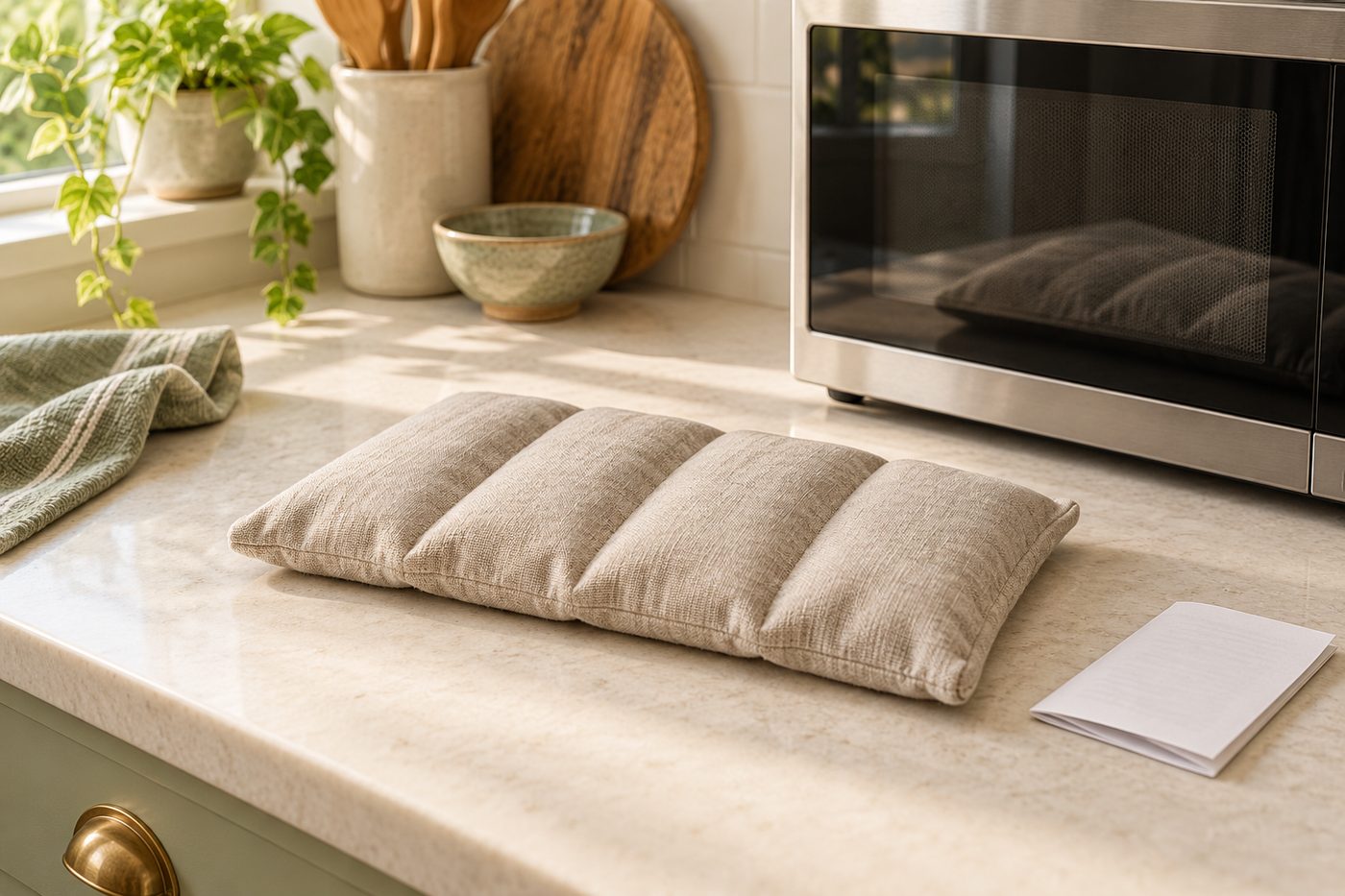
A microwaveable heat pack is a fabric pouch with filling that retains warmth for a limited period after heating according to its manufacturer's directions. Products may contain wheat, buckwheat, seeds or another material. Some have a separate washable outer cover. A similar-looking cold pack, scented cushion or decorative pouch is not automatically approved for microwave use. The name on a shop listing is not a heating instruction: identify the exact item and read its label before switching on the oven.
This guide concerns ready-made products and cautious household use. It is not a do-it-yourself sewing pattern or a recommendation to treat pain. Fire services and product-safety agencies warn that uncertain filling, moisture and dimensions make a homemade pack particularly difficult to heat predictably. A commercial pack can also become unsafe through overheating, repeated heating before cooling, covering it in bedding or continued use after damage.
Compare fillings without guessing heating time
Filling affects weight, flexibility and smell, yet the grain name alone cannot establish a safe microwave duration. The pack's mass, section design, remaining moisture and oven wattage matter too. Two products called wheat bags can have quite different instructions. Ask the seller to identify the filling and show the precise model's heating directions rather than relying on a promise of instant warmth. Choose a scent-free version if you dislike the natural odour of the filling.
Organic fillings can dry with age and repeated heating. Product Safety New Zealand and Fire and Rescue NSW link overheating and reheating before complete cooling with burn and fire risks. Do not add essential oils on your own initiative: oil absorbed by fabric can change its fire behaviour. If a pack smells scorched, perfume is not a solution. Stop using it and follow the disposal advice for the product.
For more information on the subject: Electric Heating Pads: How to Choose One and Use It Safely.
Choose dimensions, shape and weight for the intended position
A small chambered rectangle behaves differently from a long wrap sold for the shoulders. Compare its length, width and weight with the part of the body where it will rest. An overly heavy pack can be uncomfortable; an oversized one may not turn freely on your microwave plate. Do not fold it to fit an oven unless that exact model explicitly permits folding during heating. Free movement on the turntable helps avoid unevenly heated spots.
Plan where the hot pack will cool after use. It needs open space on a suitable non-combustible surface, away from textiles and children. Check that any neck-shaped product sits in place without straining its seams. A lifestyle photograph on a bed does not grant permission to sleep with the pack or leave it under a duvet. Our electric heating pad guide covers a different appliance with a cord and controller.
Understand the cover and the inner pouch
A removable cover can simplify laundering, but it is not the same thing as the inner bag of filling. Check whether the complete item, only the inner pouch or a particular configuration goes into the microwave. A care label on the cover is not enough to tell you how to heat the filling. Look for intact seams, no escaping grains and no metallic trim or accessory that is unsuitable for microwave use.
Follow the model's cleaning directions. Do not soak an organic filling merely because the outer cover is machine-washable. Trapped moisture can change the product, while an improperly dried cover should not be refitted. If regular washing is important in your household, find out whether replacement covers for that model exist. Fabric softness and appearance matter, but put legible heating and safety instructions ahead of colour, fragrance or packaging.
Read the heating instructions by microwave wattage
Find the table or label that matches a heating period to microwave power in watts. The stated interval belongs to that product, not all wheat or seed packs. Make sure you understand your own oven's power setting and whether the printed duration is a total time or one stage. If instructions are missing or unclear, do not guess or borrow the timing from another brand. Fire services have documented incidents where a wrong time was entered on the microwave.
Check whether packaging or a cover must be removed, where the pack should sit on the plate, whether it should be turned between stages, and what the manufacturer says about a second heating. Manufacturers and public agencies differ on putting a cup of water in the oven with a pack. There is no universal water-cup rule in this guide: follow the specific approved directions for your heat pack and microwave, without improvising additions or extending the time.
Inspect before every use and watch the microwave
Before heating, check for tears, loosened stitching, scorch marks, a burnt smell or filling escaping. Retire a pack showing any such warning. Make sure the microwave cavity is clean, the turntable rotates freely and the pack will not rub against the sides in a way the directions prohibit. Remove any unapproved packaging, metal component or unsuitable tag. Select power and time deliberately, then double-check the digits before starting.
Stay nearby while it heats. If there is smoke or a scorched smell, stop the cycle and follow your oven's fire-safety guidance; additional heating will not make the pack usable. Fire and Rescue NSW has documented fires involving wheat bags overheated in an oven or later placed in bedding. Heating carefully means supervising the whole process, not trusting a timer while leaving the kitchen.
Check the warmth against your skin
Remove the pack carefully as its instructions direct. Feel for uneven or excessive heat before applying it to the body. Test cautiously against a suitable part of your arm rather than pressing it against one area for a long time, and use any cloth barrier the manufacturer requires. NHS heat-therapy information says to remove a heat source if it feels too hot or uncomfortable. Prolonged contact with exposed skin can cause burns even if the warmth felt pleasant at first.
People with reduced heat sensation, damaged skin, circulation problems or a relevant medical condition need individual advice before using heat. For children and people who rely on help, an attentive adult should check both the pack and the skin. This article does not claim that warming is a treatment for any diagnosis. Stop use if there is stinging, persistent redness or a burn, and seek appropriate first-aid or clinical advice.
Why it must not warm a bed
A pack under a blanket, pillow or mattress cannot lose heat the same way as one lying uncovered. Fire and Rescue NSW and product-safety bodies warn that an overheated filled pack placed in bedding can smoulder or ignite. Do not use it as a bed warmer or fall asleep with it. The warning still matters when the outer fabric feels only mildly warm, because conditions inside the filling may differ.
Do not put a hot pack in a bedding box, bag, pile of laundry or closed vehicle seat. Place it in the open on an appropriate surface while cooling. A comfortable evening routine does not justify ignoring a product warning. Our bedroom environment guide covers lighting and room temperature without placing an improvised heat source inside a bed.
Cool completely before reheating or storage
Let the whole pack cool to room temperature before heating it again. A lukewarm outer cover does not prove the filling has fully cooled. Product Safety New Zealand notes that complete cooling may take about two hours, though the actual period depends on the pack and surroundings. A shorter second microwave cycle is not a workaround for a cool-first instruction. If you need continuous warmth, a microwaved pack may not suit that use.
Store the item only after complete cooling, in a dry place and according to its label. Keep the original instructions with it so the heating period is not lost. An item stored for a long time deserves a fresh check of seams, smell and filling. If you suspect scorching or overheating, do not put it back among bedding or try one more cycle to see whether it still works.
Know when to replace the pack
No universal number of heating cycles applies to every product. Replace a pack with a tear, leaking filling, discolouration, unusually hard or dry patches, a charred smell or a manufacturer-specified end of life. NSW Government warns that ageing and drying filling can increase combustibility. A fresh cover does not repair a scorched inner pouch. Retain the model name so you can retrieve instructions or check relevant product-safety notices later.
If the pack looks sound but its heating instructions have disappeared, request a copy from the maker or seller rather than trusting memory. A listing without an identifiable maker, filling composition or wattage guidance leaves a buyer unable to use it confidently. Responsible selection considers use, cleaning, cooling and retirement as well as comfort at the point of sale.
A practical shopping checklist
Before buying, find the manufacturer and model, filling material, dimensions and weight, fabric composition, which part is heated, and a timing table for your microwave wattage. Check whether the cover is removable, what may be washed, how the product must cool and whether warnings apply to children or certain health conditions. If the page offers only a photograph and a claim of hours of warmth, request the full directions. This guide does not quote a price or link to an unverified retail item.
Compare two packs by how clearly you can follow their instructions in your own home, not only by colour, smell or shape. Make sure the pack fits the turntable and there is a safe cooling surface. Keep the instructions with the product and tell other household members not to reheat it before it is fully cool or use it under bedding. If its behaviour or smell changes, stop and investigate. Purchase links on MyViro currently lead to retailers in Israel only.
What to compare before buying a microwave heat pack
| Feature | Question for the seller | Why it matters |
|---|---|---|
| Filling and design | What does it contain and how is filling divided? | Understand weight, shape and care |
| Heating | What time matches my microwave wattage? | Avoid dangerous guesswork and overheating |
| Cover | Which part can be washed and which enters the oven? | Protect filling and seams |
| Cooling | When may it be reheated and where should it cool? | Avoid heat trapped in textiles |
Frequently asked questions
How long should a microwave heat pack be heated?
Only for the period given for the exact product and your oven wattage. There is no single safe time for all fillings and sizes.
Should I put a cup of water in the microwave with it?
Recommendations differ among manufacturers and public sources. Follow the pack and oven instructions rather than applying a universal rule.
Can I reheat it while it is still warm?
No. Safety authorities warn against reheating before it has cooled completely; the filling can stay hot after the cover feels lukewarm.
Can I sleep with a microwaveable heat pack?
Do not use it to warm bedding or fall asleep with it. Bedding traps heat and has been associated with fires and burns.
What if it smells burnt or has scorch marks?
Stop use, let it cool on a safe surface and follow safety directions. Do not heat a scorched pack again.
Can the pack be washed?
Only the parts explicitly approved by its maker. A washable removable cover does not mean the organic filling can be soaked.
Sources and scope
Sources checked on 26 October 2026. Model details apply only to the specified product; the measurement and storage suggestions are practical guidance, not the result of our own product tests.
- NSW Government: Heat pack and hot water bottle safety
Overheating, reheating, bedding and contact-burn risks, plus model directions.
- Product Safety New Zealand: Wheat bags
Selection, supervised heating, full cooling, deterioration and storage.
- Fire and Rescue NSW: Wheat filled heat packs
Fire incidents, bedding risks and signs that a pack should be retired.
- Calderdale and Huddersfield NHS: Ice and Heat Treatment
Skin-contact precautions for heat therapy; not instructions for a particular retail pack.
By MyViro.
The content explains textile characteristics and is not the result of a product test in a laboratory. How we prepare our guides
Illustrative photos on this page were created with AI.