Double bedding begins with three measurements
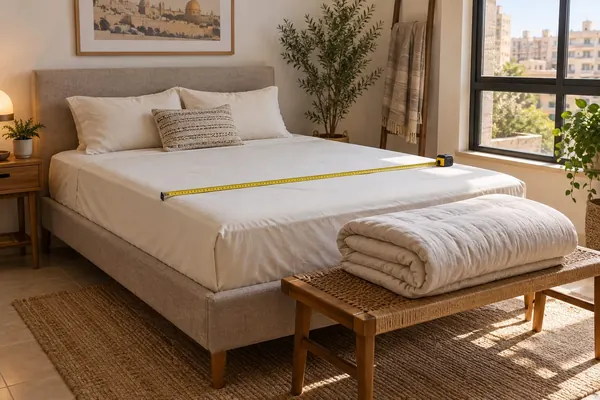
When changing to a new double bed, old bedding may not fit even if both beds are called doubles. Record actual mattress width, length and height, excluding frame and headboard. Include a topper if the sheet encloses it. A label photo and saved measurements make comparisons easier without relying on memory.
Double, queen and king names cannot replace specifications. Several dimensions coexist within one market and names can mean something different overseas. Do not purchase by width alone where length differs. List the sheet, duvet and pillows separately before choosing fabric or pattern. This reveals which existing components remain useful and which genuinely require replacement.
What does a 160 × 200 set describe?
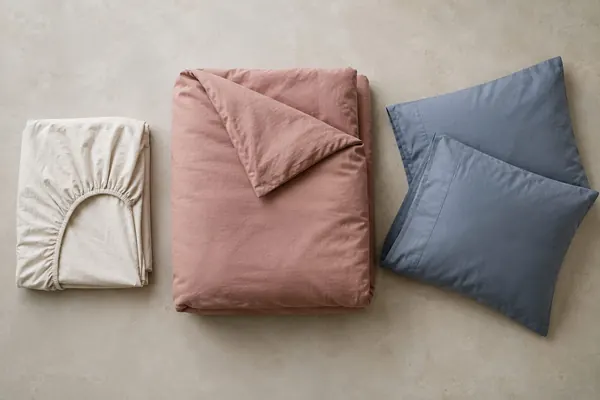
A set title’s dimension may describe the sheet or intended mattress, not every fabric item. FOX HOME’s Solid example lists a double sheet at 160 × 200 with a stated 30 cm fabric height, a 200 × 220 cover and two 50 × 70 cases. Sheet size is selectable. These are model-specific figures, not a standard or universal double-mattress approval.
Read the selected option’s contents. A selector can change the sheet without changing every component, so inspect the final combination. A height in a dimension field may not establish maximum mattress compatibility; ask where the range is unclear. Two photographed pillows do not prove two included cases, and a pictured duvet is not necessarily supplied.
For more information on the subject: Bedding size guide: Israeli bedding size charts by bed type.
Double bedding: decisions before purchase
| Check | Information needed | Practical decision |
|---|---|---|
| Sheet | Width, length and total height | Approved fit for the actual mattress |
| Two mattresses | Each side’s size and movement | Follow base directions and separate equipment needs |
| Cover | One or two duvets and their sizes | Compatible quantities and dimensions |
| Cases | Pillow size, volume and count | Do not assume identical pillows |
| FOX HOME Solid example | 160 × 200 sheet; 200 × 220 cover; two 50 × 70 cases | One model’s specification, not a double-set standard |
| Care | Home washing, drying and changes | A routine both users can maintain |
Sheet depth and total mattress height
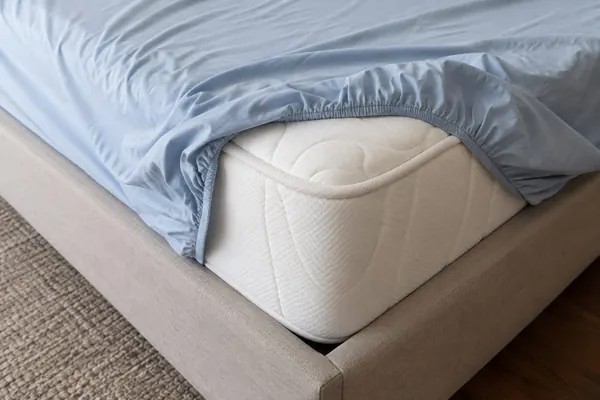
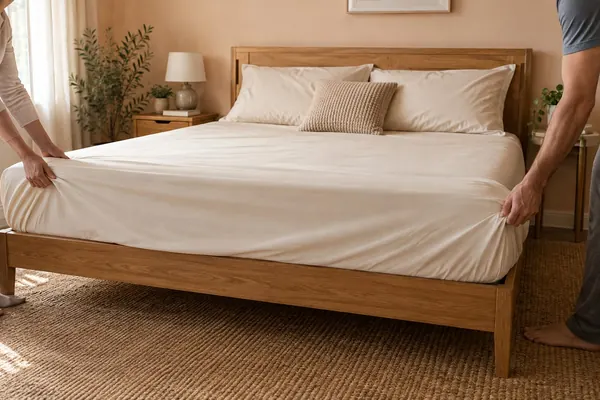
Check mattress height with the permitted layers you actually use. Correct width and length can still leave a sheet too shallow, especially after adding a topper. Conversely, a very deep pocket is not automatically suitable for every shallow mattress. Seek the maker’s approved height range and the model’s grip construction.
Pocket depth, skirt height and compatible mattress height differ. Some fabric must pass beneath the mattress, so no fixed conversion formula applies. Send all three measurements to the seller if the specification is incomplete. Do not resolve incompatibility by forceful pulling or attachments before investigating. On an empty bed, inspect every corner, including the wall side, and the centre without distorting the mattress.
One mattress, two mattresses or an adjustable base?
A double frame may hold one mattress or two. When sides separate or move independently, total width alone cannot select the sheet. Measure each mattress and note whether heights match. Check the base instructions for separate or shared sheets. Wide elastic does not establish safe compatibility with every arrangement.
Adjustable movement can pull corners or catch fabric in mechanisms. Choose approved equipment and test permitted positions on the empty bed. Preserve easy removal for washing without multiple attachments. If sides need different sizes, separate components can complete coordinated bedding simply. A shared visual design does not require one size or mechanically joining all pieces.
A shared duvet or two separate duvets?
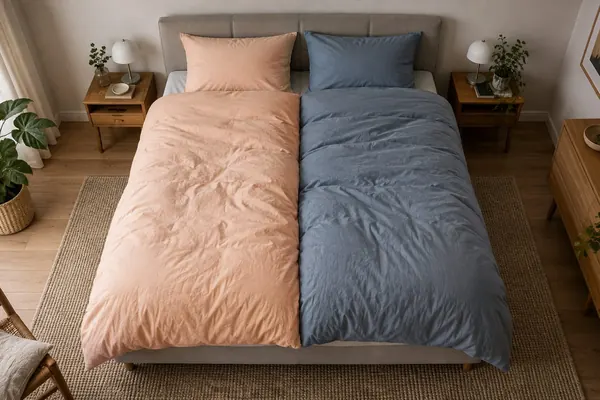
Choose cover dimensions from the duvet, not mattress width. Two-duvet users need two matching covers even on a wide bed. A ready-made set may include only one double cover. Measure both edges of existing duvets laid flat and choose each cover separately. Single and double are useful search terms, not enough for an order.
Different cover preferences may make two duvets convenient. This is a practical arrangement, not a promised sleep improvement. Coordinate colour without identical thickness or retain one cover and add another. Verify package contents against this plan before buying. A good existing duvet need not be replaced merely because it mismatches a cover in an attractive set.
Pillows and cases: dimensions and closure
Record dimensions for every pillow and find a suitable case. Two pillows need not have equal size or volume. A tight case can compress a pillow, while excessive fabric can feel inconvenient. Envelope-flap length or zip construction affects use too. Check dimensions and closure on the actual product.
If two cases are included, confirm both suit the pillows. Different pillows can use a separately bought case rather than changing a person’s pillow preference. Decorative covers are not automatic replacements for sleeping cases. Select comfortable facial-contact seams and feasible washing care. Skin or hair treatment promises cannot establish compatibility, and all pillows need not look identical.
Agree on feel without universal claims
Two people can prefer different textures. Feel a fabric sample and seams together instead of relying on luxury wording. Cotton is a fibre, percale and sateen are weaves, and jersey is knitted. CottonWorks describes percale as crisp and sateen as smooth, but yarn and finishing also affect the actual product. This is not one compulsory ranking for both users.
Start from a familiar preference and compare an alternative. One person can use another pillowcase without replacing the entire set. Read fibre percentages rather than range names. High thread count does not guarantee comfort, uninterrupted sleep or medical benefit. If warm, examine duvet, protector and room too. Changing every layer together makes it harder to identify what affected feel.
Read contents rather than photography
List sheet, cover and cases individually with sizes and quantities. A double set may contain four or five pieces, or only a cover and cases. A headline count is insufficient. Check fitted versus flat sheet, one versus two covers and compatibility of each piece. Photographic accessories may not be included.
Decide what will be used and what remains missing. An incompatible cover can make a cheap set unhelpful. Separate pieces can fulfil the plan without unnecessary contents. Compare complete purchase costs, including an extra case or spare sheet. Save the chosen option’s details: the photograph may remain identical while quantities or dimensions change between selectable packages.
Care both users can maintain
Before buying, check permitted washing, drying and ironing. Cotton bedding has no universal heat instruction. GINETEX explains maximum wash temperatures and additional treatment marks. Check every component, especially mixed fabrics or decoration. If a dryer is always used, permission is part of selection rather than an after-purchase detail.
Plan feasible care: who removes bedding, where it dries and when the next set is ready. Ironing need not justify a purchase, but required care you will not perform can make a fabric unsuitable. Dose detergent as directed and do not perfume dampness away. Change soiled components as needed; a single dirty case does not automatically require washing every part of the set.
Check after washing and during use
Follow required initial care and dry completely. On the empty bed inspect four corners without forceful stretching. Seek a smooth surface and grip consistent with directions. Prewash compatibility does not prove unchanged fit after care, so reassess a new set.
Insert the duvet and look for folded filling or inconvenient surplus. Inspect case seams and closures. Compare changes with measurements and the care label, keeping treatment details. Return rules vary and should be checked beforehand, particularly for opened or washed goods. A slipping sheet can reflect dimensions, height or elastic rather than needing another item bearing the same size name. The slipping-sheet guide explains focused checks.
Plan spares around the household routine
Maintain spares according to laundry time and actual use. Rapid drying creates different needs from line drying for a full day. Cases may be changed more often than covers, so plan components independently. There is no magic double-set count or reason to accumulate incompatible bedding.
Store dry pieces accessibly and label dimensions where several beds coexist. Group a set inside a roomy case or organise sheets by mattress and covers by duvet. Two-duvet arrangements need corresponding labels. Periodically inspect elastic and seams and remove unsuitable items from use. A useful cupboard returns the correct piece at changeover rather than merely holding numerous sets purchased for matching colour.
A practical shared choice
Before payment compare the specification with measurements and equipment. Confirm each size, case quantity, fit height, closure and care. Request missing information rather than guessing from photographs. Where users differ, decide what must be shared and what can be separate: sheet, cases or duvets. The shop’s preassembled combination need not define the decision.
The bedding size guide explains measurements and the separate-bedding guide helps build a list. Save the selected specification beside bed dimensions. Future purchases become simpler even in another colour. Suitable bedding supports convenient care, changes and use for both people without requiring identical pillow feel or one duvet preference.
Double bedding: choose each component

- Sheet for mattress dimensions and height
- Covers for one or two duvets
- Cases and care for both users
Video: measuring mattress length and width
THE SLEEP COMPANY demonstrates measuring length and width when choosing a mattress. This commercial English-language demonstration does not replace measuring the actual mattress and added layers height for a protector or fitted sheet, as explained in the article.
By THE SLEEP COMPANY · Video language: English
On this article, the player loads when the page opens, without autoplay, unless you chose to block external content. Player privacy information
Open the video on YouTube (in a new tab)
The article can be read without watching. Captions depend on the options available on YouTube; the explanation is not a transcript.
Frequently asked questions
Which set fits 160 × 200?
Its sheet must support those dimensions and height; other pieces must fit the duvet and pillows.
Are all double covers 200 × 220?
No. Check duvet measurements and the cover specification.
Can two duvets be used?
Yes as a suitable arrangement; obtain two matching covers rather than assuming set inclusion.
Does 30 cm fabric height mean a 30 cm mattress fits?
Not necessarily. Request the approved mattress-height range.
How many cases are included?
Use the selected option’s contents, not the photograph.
Must every component use one fabric?
No. Assemble compatible pieces for feel, dimensions and care.
Does slipping require clips?
Check dimensions, height and elastic first; attachments do not approve fit.
Sources and scope
Sources checked on 12 October 2026. Manufacturer sources describe their own products and instructions; they do not establish one universal rule for all bedding and mattresses.
- FOX HOME: Solid set component dimensions
Example with a 160 × 200 sheet, 200 × 220 cover and two 50 × 70 cases; fabric height needs clarification of compatible mattress height.
- IKEA: LÄKEVÄNDEROT cover and case
Example of a 150 × 200 cover and 50 × 70 case package without a sheet; not a purchase endorsement.
- CottonWorks: home textile guide
Industry source for percale and sateen feel descriptions; superiority and health claims are not adopted.
- GINETEX: textile care symbols
Explains care limits; the actual item’s label governs treatment.
By MyViro.
The content explains textile characteristics and is not the result of a product test in a laboratory. How we prepare our guides
Based on material from the MyViro archive, rewritten and reviewed on 12 October 2026.
Illustrative photos on this page were created with AI.