How to use a breastfeeding pillow during a feed
A lactation consultant demonstrates pillow placement and support during a feed. This short supervised-feeding demonstration is not a recommendation to let a baby sleep on the pillow or proof that one model fits everyone.
By JANZ · Video language: English
On this article, the player loads when the page opens, without autoplay, unless you chose to block external content. Player privacy information
Open the video on YouTube (in a new tab)
The video illustrates this topic. The full article remains available without watching; captions and transcripts depend on the publisher and YouTube.
What is a nursing pillow for?
A nursing or breastfeeding pillow is a support accessory used during feeding. It may support an adult’s forearms or help bring a baby to a comfortable feeding height, but it is not essential for every family and never replaces holding the baby. Some parents use an ordinary pillow under an arm; others prefer a purpose-shaped pillow that is easier to place for each feed. The useful question is whether it helps you sit comfortably while keeping the baby close and well positioned.
Israel’s Ministry of Health advises choosing a comfortable position, bringing the baby towards the adult without leaning over, and supporting the baby’s body along the back and neck. A pillow may support the adult’s arm or back; its shape alone cannot fix persistent feeding pain or poor attachment. If feeding hurts, the nipple is injured, or you worry about intake, ask a breastfeeding counsellor, health visitor or clinician for help. For the next step after a feed, see our safe infant sleep guide.
U-shaped, straight or strapped: compare the designs
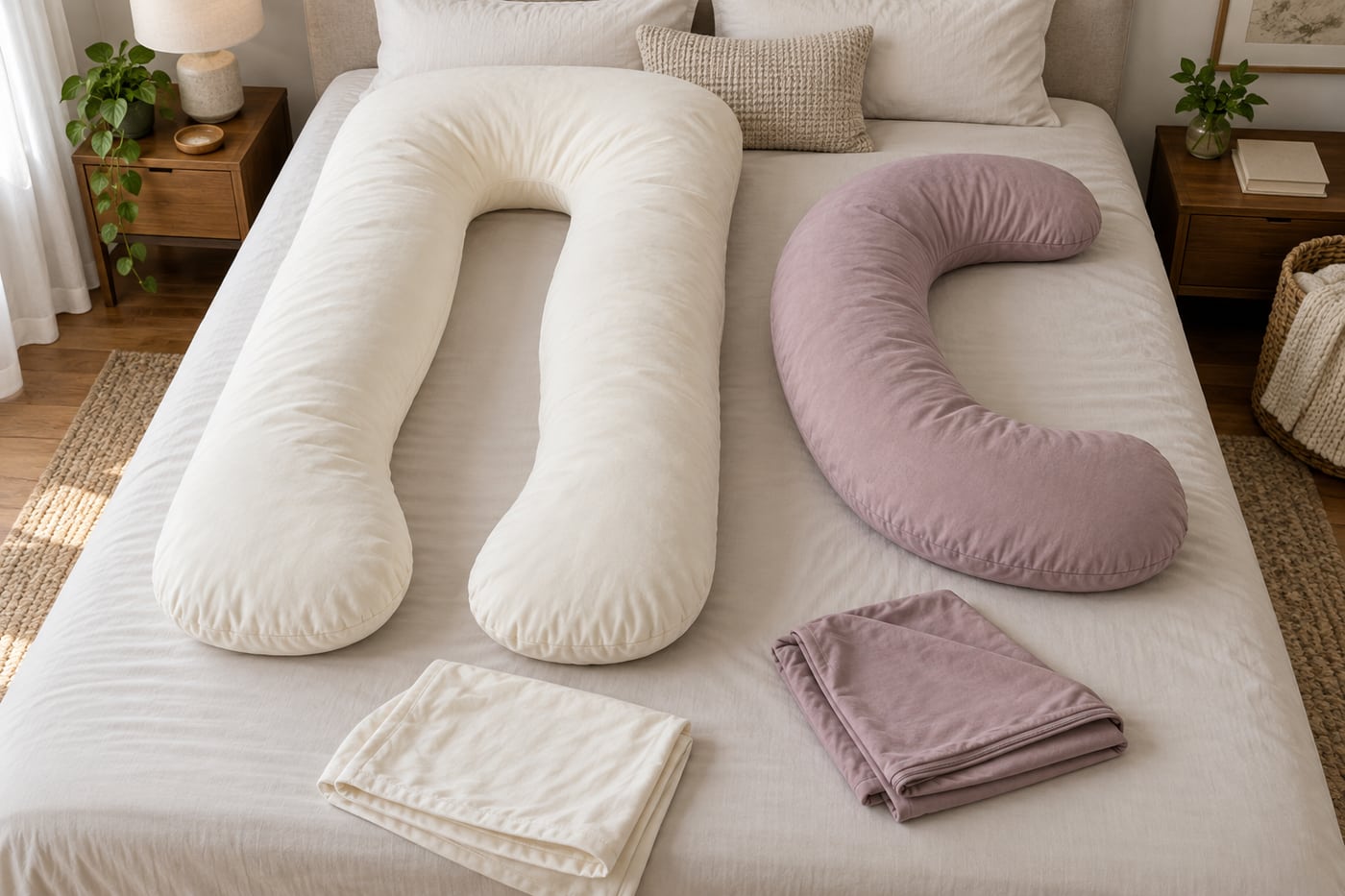
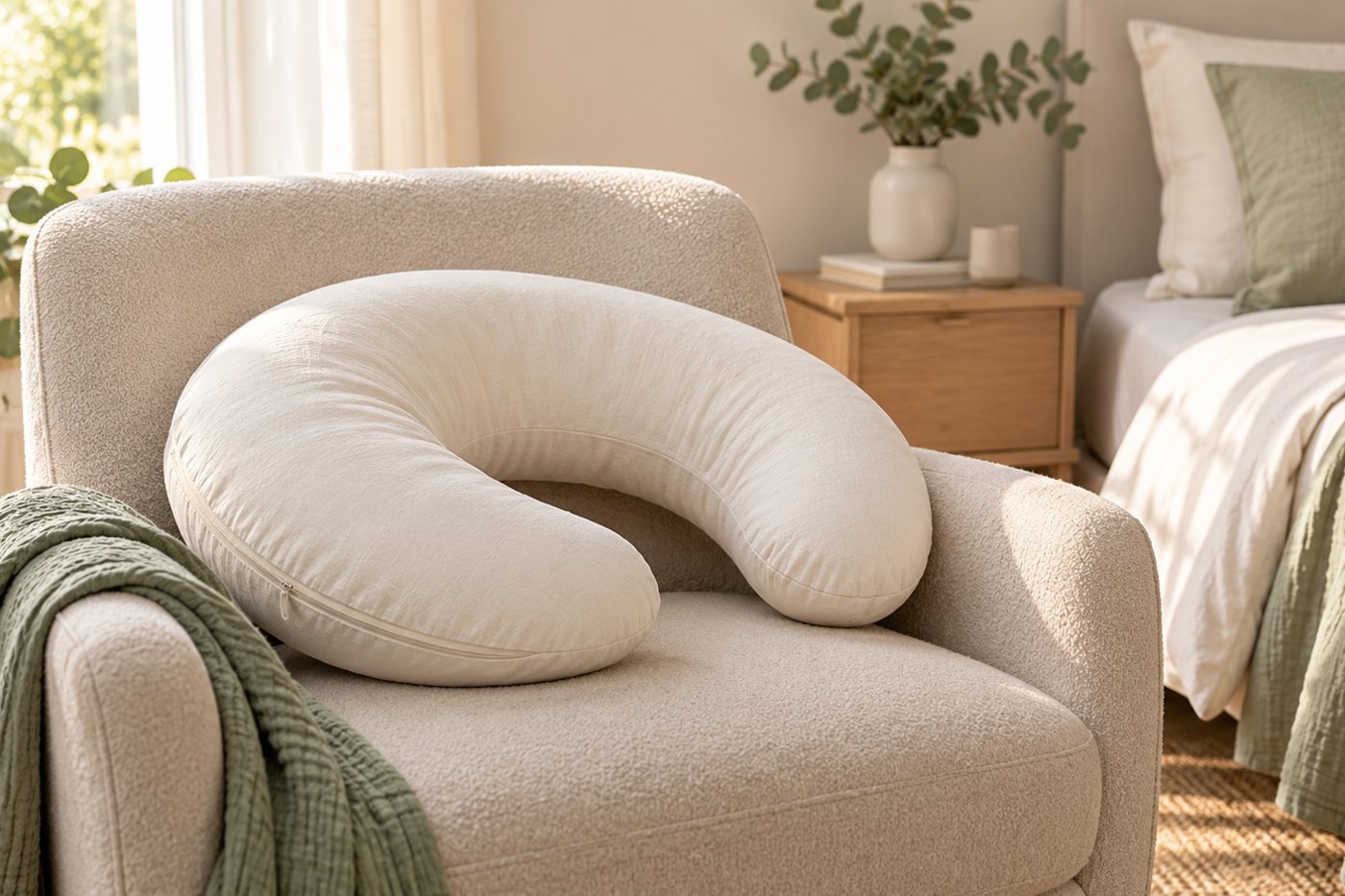
A U-shaped pillow wraps around the adult’s waist and creates support across the lap. It may suit seated feeds and support the arms on both sides, but the curve and opening vary greatly between models. A straight or narrow pillow offers targeted support on one side and may fit a smaller chair. Some models add a fastening strap, a raised back section or a firmer platform. Each feature changes the fit, cleaning routine and ease of passing the pillow to another caregiver.
Do not select a shape by appearance alone. Think about the chair’s width, your body, and the feeding holds that already work. A wide pillow might push the baby away; a low one may leave you hunching forward. Check the listed dimensions, strap closure and the manufacturer’s usage instructions. The shape comparison is a starting point for trying a design, not a universal ranking. A pillow that supports another parent well can feel awkward in your own chair.
For more information on the subject: Choosing a Pregnancy Pillow by Shape, Size and Care.
Find the height that works for your body
For a seated feed, first settle with your back supported, shoulders relaxed and feet stable. Then place the pillow to support your arms or bring the baby to a useful height without pressing the baby’s face into the breast or making you bend over. The NHS explains that the baby’s head and body should be aligned, close to you and facing you. Israel’s Ministry of Health likewise advises bringing the baby to the breast rather than the breast to the baby. A pillow is only an aid to that position.
The height shown in a product photograph may be wrong on your sofa. A deep seat, high armrests or soft cushions change where the pillow rests. If you can try a model in a shop, sit in a position resembling the one you use at home and notice where your forearms land. For an online order, seek stated height and thickness, return terms and usage instructions. Avoid stacking loose cushions to make an unstable base around the baby.
Filling, firmness and everyday feel
Very soft filling may compress under your arms during a feed and lose useful support. A very rigid pillow may feel uncomfortable or make it harder to adjust the baby’s position. See whether the pillow holds its shape when the arm rests on it, while still allowing you to bring the baby close. There is no single firmness score that fits everybody. Product specifications should identify the filling, cover and care instructions, while actual comfort depends on both your body and the chair.
Look at seams, zips, buttons and edges as well. If a part becomes loose or torn, stop using the pillow until you have checked the maker’s instructions. Do not rely on a claim that a certain cushion cures back pain, nipple soreness or attachment problems. Those difficulties require attention to feeding technique and sometimes professional assessment of parent and baby. A support pillow may make a position easier to maintain; it is not a medical treatment or a substitute for feeding support.
A removable cover makes cleaning more practical
Milk drips, spit-up and frequent handling make the cover a practical part of the buying decision. Check whether it comes off, whether a spare is sold, and what the care label says about washing temperature, drying and ironing. A cover that is simple to remove and replace may prove more useful than an attractive fabric that is awkward to clean. Never assume the whole pillow is machine washable merely because its cover can go in the wash; different fillings need different care.
Read the composition of the fabric touching adult and baby skin, see how the zip closes, and check whether the closure stays out of the way during feeding. A spare cover is useful only if it fits the exact model without loose excess fabric. If the cover or filling becomes wet, dry it according to the manufacturer’s instructions before storing it. An unusual smell, opened seam or damaged fabric calls for inspection, not simply covering the problem with another layer.
Using the pillow for breast or bottle feeding
A nursing pillow can also support an adult during a bottle feed when the model’s instructions allow that use. In either case, the goal is to support the caregiver’s arms while retaining full control of the baby. Never leave an infant propped on the pillow to feed alone, and never use it to hold a bottle in place without an adult. Keep watching and holding the baby in a position appropriate to their age and the guidance you have received from health professionals.
For a cradle hold, ask whether the edge under the supporting arm reaches a comfortable height. With a baby held to the adult’s side, check that the pillow does not open a gap between them. For side-lying breastfeeding, a U-shaped pillow around the waist may be irrelevant; adult back support may be more useful under professional guidance. Do not force an uncomfortable feeding hold just to justify a purchase. The NHS and Israel’s Ministry of Health describe several possible positions, none of which requires one pillow design.
Nursing pillow versus pregnancy pillow
A long pregnancy pillow is generally intended to support an adult’s body while resting. A nursing pillow is usually smaller and shaped for targeted arm support or seated feeding. Some products are advertised for both purposes, but a marketing name does not establish a good fit for either. If you already own a pregnancy pillow, consider whether it can support your arm without bunching fabric near the baby’s face or compromising your hold.
Adult comfort and infant sleep safety are separate issues. A cushion sold as a pregnancy-and-nursing pillow is not thereby an infant mattress, sleep positioner or seat. Our pregnancy pillow guide covers choosing support for an adult; this article focuses on feeding and the practical differences between nursing-pillow shapes. Before buying, decide how you will use the item most often: adult rest, seated breastfeeding or bottle feeding. The answer is more useful than a broad “multi-use” claim.
Safety: never use a nursing pillow for infant sleep
Use the pillow only during active feeding with an awake adult supervising, and follow the manufacturer’s instructions. Never leave a baby on it unattended and never put it inside a cot, bassinet or play yard as a sleep product. The American Academy of Pediatrics and the US Consumer Product Safety Commission warn that nursing pillows are not designed for infant sleep; unsafe positions on soft products can obstruct breathing. If a baby falls asleep during or just after feeding, move them to their own appropriate flat, firm sleep surface under local safe-sleep guidance.
Israel’s Ministry of Health also stresses keeping pillows away from the baby’s sleep environment. Those recommendations matter more than a promotional photograph showing a baby asleep on a cushion or a broad “multi-purpose” label. Do not use a nursing pillow to elevate an infant for spit-up, as a substitute for a baby seat or as a sleep positioner. If you are exhausted during night feeds, plan a safe place to transfer the baby afterwards rather than depending on a pillow to hold a sleeping position.
A useful product-page checklist
Compare a few models using the same questions: What are the outside dimensions and opening width? What is inside the pillow? Is the cover removable? How does each part get cleaned? Is there a strap? What do the maker’s safety warnings and usage instructions say? Look for a photograph of the pillow alone as well as one showing its placement during a feed, but do not infer from a model photograph that its height fits you. Compare its width with the chair or seating area at home.
If spare covers are offered, confirm that they fit the precise model. Consider where you will store the pillow and whether it is easy to move from room to room without carrying a baby at the same time. A high price or a label such as “orthopaedic” does not prove comfort or safety. Keep the instructions after purchase and check warnings about age, product condition and feeding position. This is a category guide, not a laboratory review of particular pillows.
A short decision routine for your family
Start with a feeding position that already works, then ask whether extra support would make it easier. Write down the real difficulty: unsupported arms, a deep chair, trouble keeping the baby close, or a cover that needs frequent washing. Try a suitable pillow while you are awake and holding the baby. Notice whether your shoulders relax, the baby stays close and the face remains visible. If the pillow raises the baby too high or opens a gap, move it or choose not to use it.
Before ordering, confirm measurements, wash instructions, cover compatibility, return terms and safety guidance. After every feed, keep the pillow away from the infant’s sleeping space. If breastfeeding remains painful or you are concerned that feeding is not adequate, seek a health visitor, lactation consultant or clinician rather than repeatedly changing cushions. In this way the pillow remains what it can usefully be: an optional feeding aid, never a sleep solution or a medical promise. Current purchase links on this site, where present, lead to stores in Israel only.
Which nursing-pillow shape should you compare?
| Nursing-pillow design | Possible advantage | What to check in a nursing pillow |
|---|---|---|
| U-shaped | Support on both sides while seated | Opening width, height and stability |
| Straight pillow | Targeted support on one side | Whether it slips or sits too low |
| Pillow with strap | More fixed placement around the adult | Closure comfort, adjustment and washing |
Frequently asked questions
Do you need a nursing pillow?
No. It is an optional support aid. Some families use another form of support; a comfortable position and effective feeding matter more than any particular model.
Can a baby sleep on a nursing pillow?
No. A nursing pillow is not a sleep surface. Move a baby who falls asleep after a feed to an appropriate flat, safe sleep space.
Is a U-shaped pillow better than a straight one?
Neither is best for everyone. Compare height, chair width, your feeding hold and whether you can keep the baby close.
Are all nursing pillows machine washable?
No. Check the cover label and filling instructions separately. A removable cover does not mean the whole pillow can be machine washed.
Can a pregnancy pillow be used for feeding?
It might support the adult’s arm or back, but check that it does not interfere with holding the baby or bunch near the face. It is never an infant sleep space.
When should you get professional help?
Seek a health visitor, lactation consultant or clinician if pain persists, the nipple is injured, attachment is difficult or you worry about the baby’s intake.
Sources and scope
Sources checked on 19 October 2026. This is general selection and usage guidance, not a product test. Seek professional advice for feeding or sleep difficulties as appropriate.
- Israel Ministry of Health: breastfeeding tips
Comfortable feeding position, keeping baby close, adult arm and back support, and help when feeding hurts.
- NHS: breastfeeding positions
Feeding holds and pillows used for adult support during feeding.
- Israel Ministry of Health: safe infant sleep
Safe infant sleep environment and avoiding pillows near the baby’s face.
- American Academy of Pediatrics: nursing pillows and safe sleep
Nursing pillows may help during feeding but are not designed for infant sleep.
- US CPSC: nursing pillow safety standard
Warning against use as a sleep surface; a US source, not an Israeli standard.
By MyViro.
The content explains choosing and safely using a nursing pillow; it is not the result of a laboratory product test. How we prepare our guides
Illustrative photos on this page were created with AI.