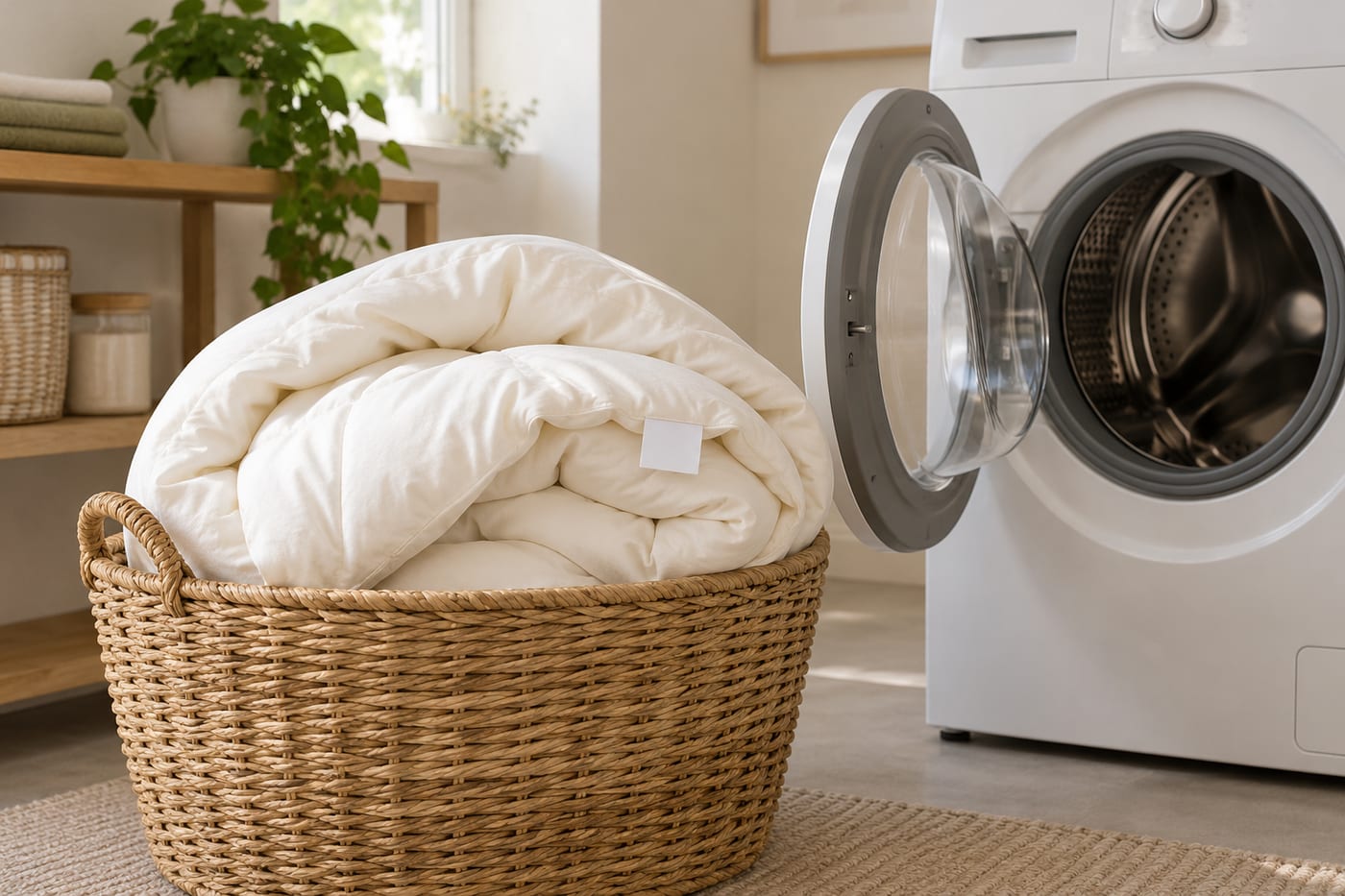
Before washing: the duvet insert or just its cover?
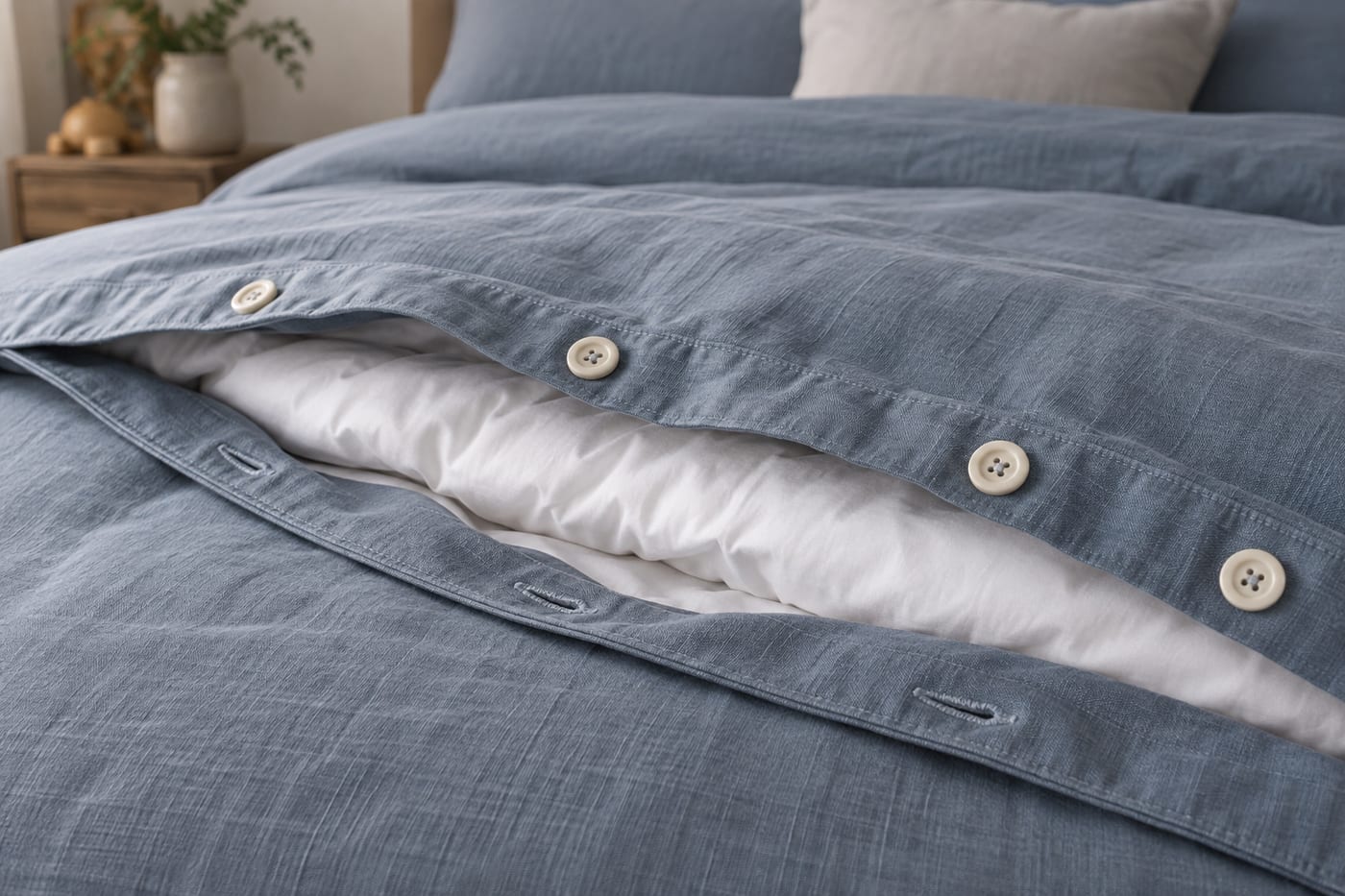
People often use the word duvet for any thick filled bed covering, including one filled with polyester. That everyday name is not enough to choose a cleaning method. A duvet cover is a removable fabric envelope, while the insert is the padded item inside it. They may have different care labels. Instructions for cotton sheets do not necessarily apply to the insert, even when its outer casing is cotton.
Remove the cover, spread out the insert and examine both labels separately. Look for detachable fasteners on an all-season set, ties or removable components. Separate them if the manufacturer instructs you to do so. You can then decide whether the filling needs a complete wash, whether a local mark needs attention or whether only the cover needs cleaning. Making that distinction avoids unnecessary treatment and helps you organise the laundry day properly.
How to read a duvet care label
Find three things: the casing and filling composition, the washing instructions and the drying instructions. A wash tub symbol does not automatically allow every cycle: numbers and bars add limits. Permission to tumble dry is a separate question. If washing is allowed but tumble drying is prohibited, arrange a suitable drying method before wetting the duvet. Do not rely on a large temperature printed on a package without reading the rest of the information.
If the label is missing or faded, find the model on the manufacturer’s website or ask for its instructions. Photograph the item and whatever remains of the label to avoid confusing similar models. Appearance, weight and price cannot reliably identify a safe cleaning method. A machine cycle called Duvet does not override an insert label specifying professional cleaning only. When the instructions are unclear, obtain them before beginning.
For more information on the subject: How to wash bedding and care for the fabric.
Duvet washing decisions by filling
| Item | Check before washing | Check when drying |
|---|---|---|
| Down or feathers | Washing permission, appropriate cycle and approved detergent | Dryer permission, heat and volume; dryness throughout the compartments |
| Synthetic filling | Padded-item directions and the cycle’s load limit | The method and heat level approved for the item |
| Wool | Whether the model is washable and needs wool detergent | Some models require air drying; do not assume tumble drying is allowed |
| Silk or specialised filling | Manufacturer directions for the complete item | Filling- and construction-specific drying instructions |
| Removable cover | The cover label separately from the insert | Fabric instructions; dry completely before replacing |
Natural down: match the treatment to the actual product
Natural fillings may contain down, feathers or a mixture. Some inserts are machine washable, but manufacturers and models have different instructions. For example, Scooms specifies a 40°C wash for its down duvets, while IKEA publishes different directions for its own products. These are examples for particular products, not temperatures you can transfer to every natural filling. Check which detergent is permitted and how much the manufacturer asks you to use.
Choose a cycle only after comparing the duvet label with the appliance manual. If a dedicated down cycle is available, check its load limit and the types of items it accepts. Do not add fabric softener, bleach or fragrance products without permission in the instructions. Wet filling may appear much less lofty after washing; that alone does not establish permanent damage. The approved drying process and a later check of the compartments are part of the treatment.
Synthetic duvets: polyester fillings are not all the same
Synthetic filling may be described as microfibre, hollowfibre or down alternative. These names indicate a family of materials or a desired feel, but do not independently determine a washing cycle. Within the same family, filling density, casing fabric, stitching and finishes vary. Look for washing and drying permission on the padded item itself, rather than borrowing the instructions for the sheets used alongside it. A familiar fibre name is a starting point for identification, not a complete care plan.
A thin duvet may fit comfortably in a drum, while a thicker one of the same dimensions may require different equipment. Do not compress it just to close the door or choose a quick cycle simply because it looks only lightly soiled. Confirm that the cycle handles padded items and check its specific load limit. If the duvet instructions and appliance manual cannot be reconciled, a laundry with suitable equipment is a practical option. Tell the cleaner about both the filling and the drying requirements.
Wool, silk and specialised fillings
Wool and silk do not automatically share the instructions for a down duvet. Some wool products are designed to be washable; others need a different treatment. Woolroom, for example, publishes directions for its washable wool duvets that include an appropriate wool detergent and air drying rather than tumble drying. Do not apply those directions to another wool duvet without checking its label. A cotton casing does not establish whether the filling inside can safely become wet.
When a duvet contains several materials, check the directions for the complete item. Do not select the easiest treatment based on just one component. Weighted blankets, electric blankets and heated covers have separate instructions and fall outside this guide. If an old item cannot be identified, or has particular value to you, show it to a professional cleaner before attempting a bath or hand wash. Hand washing is not necessarily gentler or safer for the filling structure.
Which washing machine can handle a duvet?
The capacity displayed on an appliance is not a recommendation for every programme. A down, wool or bulky-item cycle may have a lower maximum load than the machine’s headline capacity. Volume matters too: a large, light duvet can fill the drum despite weighing relatively little. There is consequently no dependable rule that every double duvet fits a seven- or nine-kilogram machine. Read the programme table for your actual model.
Check the padded-item limits and the recommended loading method. Load the duvet as instructed, without packing it so tightly that it cannot move. Do not add towels to fill the drum when the directions call for washing separately. If the machine refuses to spin or reports imbalance, stop and follow its manual rather than repeatedly selecting a stronger spin. Before taking the duvet to a laundry, confirm that the service can also dry it by a method permitted for that product.
Preparing the duvet and checking stains
Examine the seams, corners and fabric in good light. A small tear or open seam could let filling escape during treatment. Repair a defect appropriately, or arrange a repair before cleaning. Check both sides for marks that need attention. Photograph an unidentified stain and the duvet’s condition before taking it to a cleaner so that you can explain what changed and when. Preparation helps you describe the problem clearly rather than relying on the blanket term dirty.
Use spot treatment only with a product and method suitable for the casing and filling. Test a hidden area as directed by the cleaning-product instructions. Do not layer several stain removers or scrub aggressively to reach the filling. If liquid has just spilled, gently blotting excess moisture may be an initial step while you establish the appropriate treatment. An extensive stain, deeply penetrated soiling or unclear instructions warrants advice from a professional cleaner instead of a series of household experiments.
Detergent, dosing and rinsing
Choose detergent that is compatible with both the duvet and the machine, and use the amount required for that combination. One universal dose in spoonfuls cannot account for different water conditions, detergents and fillings. Some manufacturers request a reduced amount or a specialised product, but that direction belongs to their item. A large dose does not guarantee better cleaning and can make rinsing more difficult. Check whether automatic dosing is enabled and how it should be configured for your selected cycle.
If the item or appliance directions call for an additional rinse, follow them. Do not add softener out of habit to restore loft. Strong perfume is not proof that a duvet is clean, and a faint smell does not necessarily mean the wash failed. If you can see residue or notice an unusual feel, review dosing and rinsing before using the duvet again. Keep the detergent packaging available until the process is finished so that you can consult its instructions if needed.
How to dry a duvet without leaving damp filling
Plan drying before washing. If tumble drying is allowed, match the dryer to the duvet’s volume and care instructions: a suitable washer does not establish that the home dryer is large enough. Select an approved programme and heat level, and do not increase the temperature just to finish faster. Some manufacturers permit dryer balls; avoid adding balls or other objects unless the instructions support their use.
If the manufacturer permits air drying, follow its instructions on spreading or supporting the item and allow airflow around it. A heavy wet duvet is not automatically suitable for a thin washing line. Drying time varies with the product, extraction, equipment and conditions, so a fixed number of minutes cannot prove dryness. Check multiple areas, including corners and thicker compartments. A dry outer casing alone is insufficient to decide that the filling is ready for a cover or storage.
Clumps after washing: what to check
Wet filling may gather within its compartments, leaving the duvet heavier and less airy. First establish whether the approved drying process has been completed. If the manufacturer recommends drying pauses, shaking or gentle redistribution, follow that guidance. Do not pull forcefully through the casing or attempt to move filling between compartments. Internal partitions may be designed to keep each area’s filling in place, so the right response is not necessarily more vigorous handling.
If a completely dry duvet still has empty sections, hard lumps or an open seam, contact the manufacturer or cleaner. Another wash is not automatically the answer and may add unnecessary treatment. An unusual smell that persists after drying also needs investigation. Compare the duvet with its earlier condition if you have a photograph. This helps distinguish a temporary change in wet filling from a structural problem, and lets you describe the issue accurately without guessing its cause.
How often should a duvet be washed?
There is no single timetable for every home or product. A regularly washed cover, seasonal use, perspiration, spills and manufacturer guidance all affect maintenance. The insert does not necessarily need washing whenever its cover is changed. Scooms’ recommended interval for its down products, for example, is not a rule for every duvet sold in Israel. Where a manufacturer gives a recommended interval, use it as a starting point and check for soiling or changes that need earlier attention.
Record when the duvet was cleaned and by which method, especially if several similar inserts are used at home. Airing as instructed may be part of maintenance, but does not replace cleaning a stain or contamination. If a particular medical situation requires hygiene guidance, obtain it from a qualified professional rather than a general bedding temperature recommendation. Do not exceed the care label in an attempt to disinfect a product not designed for that treatment; ask about an appropriate alternative.
When professional cleaning is a sensible choice
Professional cleaning is useful when the home programme or drum volume is unsuitable, approved drying is unavailable, the label requires professional treatment or the soiling is complex. Tell the cleaner the filling, dimensions and nature of the stain, and show the care label. Ask which cleaning method will be used and how the filling will be checked for dryness before packing. Professional cleaning does not necessarily mean dry cleaning; the method must match the item’s symbols.
Ask whether all-season fasteners need removal and whether a small tear can be repaired before cleaning. If there is no label, state that explicitly instead of assuming the service will identify the filling. Photograph the item before handing it over, keep the service information and examine it on return. Do not put a bag containing a damp-feeling duvet straight into a cupboard. Open and check the item according to the service’s instructions, and request advice if its smell or structure has changed.
Replace the cover and store only after a final check
Once the duvet is completely dry and you have checked the filling, replace a clean cover of an appropriate size. Align the corners without pulling on the fabric and attach ties or fasteners as the manufacturer describes. If the insert bunches inside the cover or leaves large empty areas, check the dimensions as well as the orientation. The bedding size guide explains why mattress size and duvet-cover size require separate checks.
For seasonal storage, use a method permitted by the manufacturer. Do not vacuum-pack a down duvet just because it saves space; some products call for storage without prolonged compression. Put the filling type and cleaning date on a card or storage case. When you next take it out, examine the casing and compartments before use. Keeping this information saves you from identifying the product and reconstructing its care instructions at every change of season.
Before washing a duvet

- Check label and filling
- Check machine suitability
- Plan complete drying
Video: how to wash a duvet
In The Wash introduces machine and hand washing of a duvet. The demonstration is general: confirm that the duvet label and appliance instructions allow the chosen method. A duvet unsuitable for home care needs advice from its maker or a professional cleaner.
By In The Wash · Video language: English
The player loads only after a click, subject to your external-content preferences. Player privacy information.
The article can be read without watching. Captions depend on the options available on YouTube; the explanation is not a transcript.
Frequently asked questions
Can I machine wash a duvet?
Yes, if its care label permits it and the appliance model and cycle suit its volume and load. The word duvet is not an automatic washing permission.
What temperature should I wash a duvet at?
Use a temperature approved for the actual product with a compatible cycle. Some products specify 40°C and others have different directions; there is no universal temperature for a filling family.
Will a double duvet fit a 7 kg washer?
The number alone cannot establish that. Check the programme limit, drum volume and the duvet’s dimensions and thickness. Do not force an unsuitable item into the drum.
Can I dry a duvet without a tumble dryer?
Only if the product permits air drying and you can dry the filling completely using the required method. Check this before washing.
Why is the duvet lumpy after washing?
Wet filling may gather together. Complete the approved drying process and check again. Persistent clumps in a dry duvet, empty compartments or an unusual smell warrant advice from the manufacturer or cleaner.
Should I add fabric softener?
Do not add it unless the product instructions allow it. The detergent type and dose must also suit the filling and machine.
Must the cover and insert both be washed?
They are separate items with separate care labels and routines. The cover may need washing more often. Check the insert’s condition and manufacturer guidance instead of automatically washing both.
Can I keep a duvet in a vacuum bag?
Only if its manufacturer permits that storage method. Prolonged compression is not suitable for every filling, and no duvet should be stored until completely dry.
Sources and scope
Sources checked on 10 October 2026. Manufacturer sources describe their own products and instructions; they do not establish one care rule for all bedding and mattresses.
- IKEA: washing duvets guide
Manufacturer guidance on filling types, care labels and planning the drying process.
- Scooms: choosing and caring for a down duvet
An example of 40°C directions for this brand’s products; not a universal down-duvet instruction.
- Woolroom: washing a wool duvet
Directions for the brand’s washable wool ranges, including air drying and product-specific limits.
- Bosch: a model-specific programme manual
Illustrates that a duvet programme can have its own load limit, below the machine’s overall capacity.
- Whirlpool: preventing laundry damage
Manufacturer advice on loading, bulky items and checking seams; consult the manual for your own model.
By MyViro.
The content explains textile characteristics and is not the result of a product test in a laboratory. How we prepare our guides