What does a quiet mattress protector mean?
A quiet mattress protector describes a use experience rather than a material identifiable by its name alone. People may mean rustling when turning, friction between layers or a bed noise mistakenly attributed to the protector. Before choosing another product, define when the sound occurs and what you want to improve. Brief fabric rustling is a different issue from a base knocking or a corner shifting with every movement.
This guide offers a way to compare specifications and investigate noise on an adult or older child’s bed according to the equipment instructions. It is not a ranking of products we tested and does not promise complete silence. Manufacturer claims are identified as claims for particular models. Where an advertisement does not provide a test method or use conditions, it cannot become a comparative measurement. A useful choice connects required protection, bed compatibility and any permitted way to assess actual use.
Locate the sound before replacing the protector
Start with a simple description: does the sound occur when a hand moves over the sheet, when you turn or when the bed moves? Does it come from one area or the whole surface? Look for a visible fold or displaced corner. You can inspect individual items during an ordinary bedding change without dismantling the mattress or removing a component that must remain in place. This is not a laboratory test; it helps identify whether the enquiry concerns fabric, fit or the frame.
Record the layers present: original cover, topper, protector, sheet and any area pad. Do not assume the waterproof item must be responsible. If sound continues without fabric movement or a bed component is loose, follow the bed instructions and contact its manufacturer. An extra layer is unnecessary for masking an unidentified sound. Precise information about the movement and location makes a discussion with the protector seller or equipment manufacturer more useful.
For more information on the subject: Mattress Protectors: Types, Materials and How to Choose.
Protector rustling: an enquiry sequence
| What occurs | What to check | What not to infer |
|---|---|---|
| Rustling when turning | Folds, fitting direction and layers | Every barrier of that material makes the same sound |
| A lifting corner | Total height and sheet/protector fit | A larger size automatically solves it |
| Sound in one area | Fold position or a bed component | The protector must be responsible |
| Quietness in advertising | Model and supplied test conditions | It is a MyViro comparison or decibel measurement |
| Noise after washing | Treatment performed and item condition | Additional heat or softener is the solution |
| Movement on an adjustable base | Explicit movement compatibility | Flat-position dimensions are sufficient |
Fit: inspect folds and excessive tension
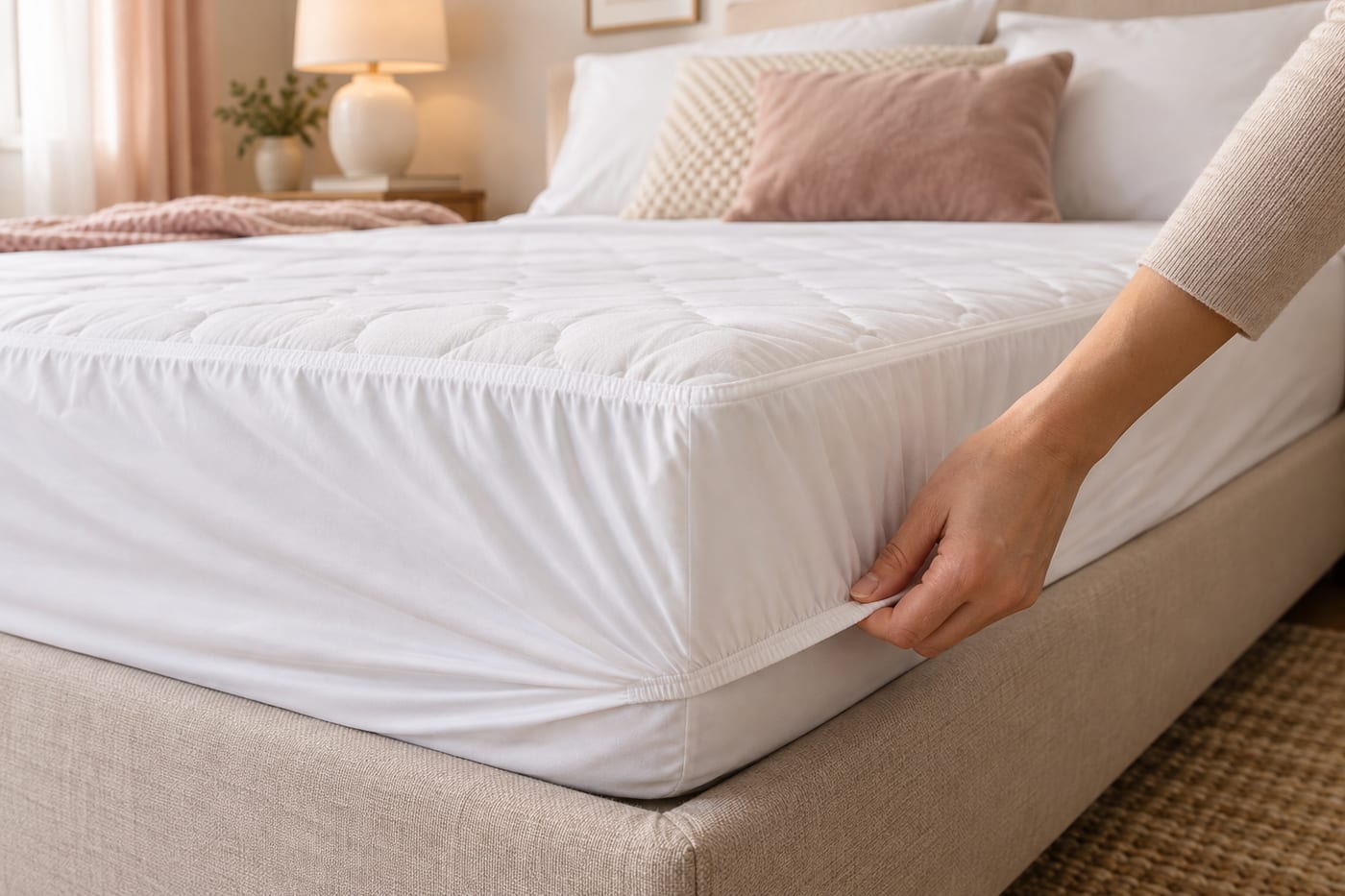
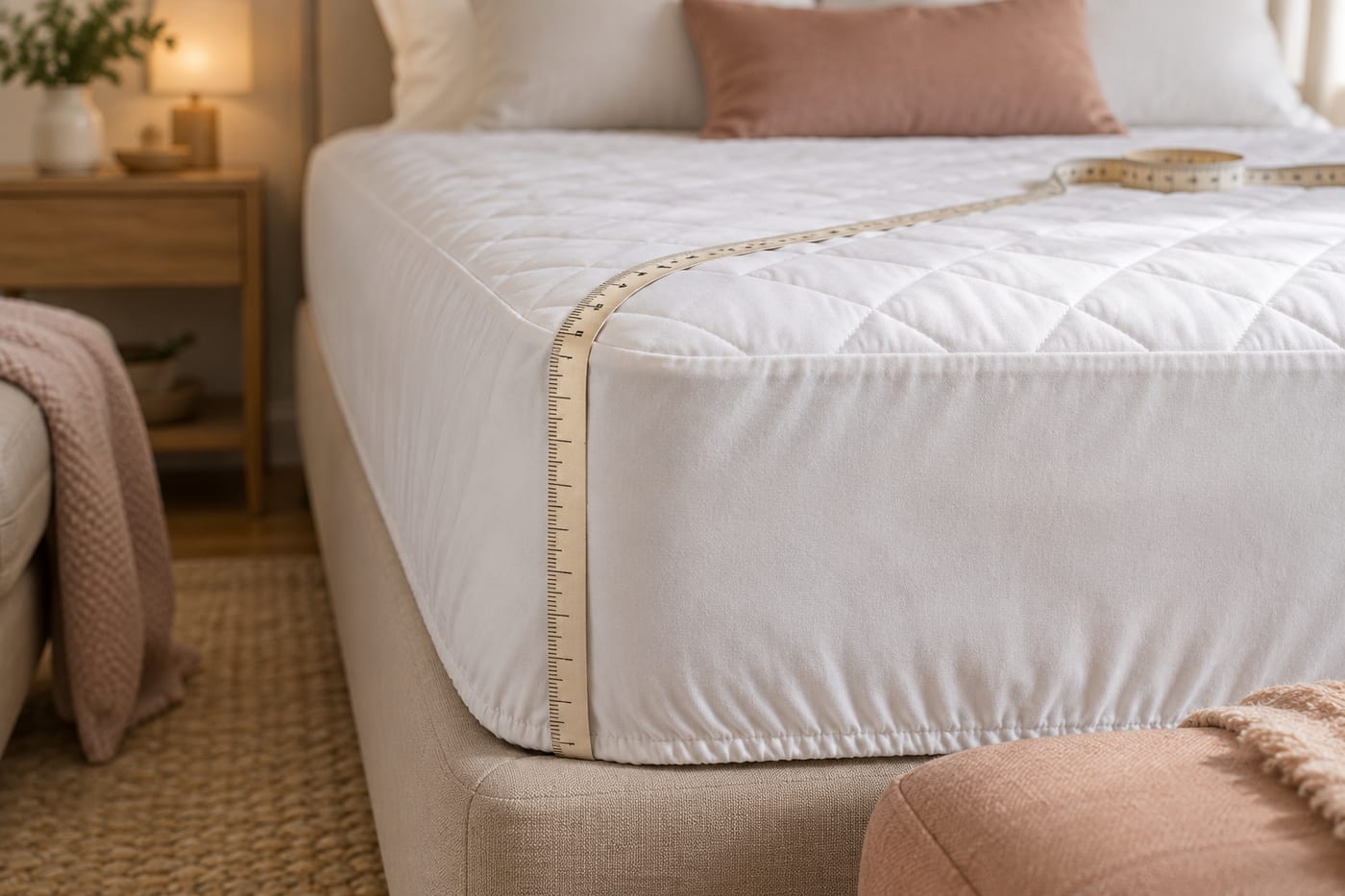
An unsuitable protector can fold or stretch, and moving fabric may not sit as the manufacturer intended. Check width, length and height, including a topper when the protector surrounds it too. Some products cover two specified lengths and others one size; do not change dimensions merely to obtain looser fabric. An oversized protector is not an assured route to quietness, and an undersized one should not be stretched to hide folds.
Check the sheet above it as well. A lifting corner may reflect a sheet unsuitable for total height rather than the protector elastic. Align both as instructed and look for pulling between them. Do not force stability using unapproved pins or clips. Our protector size guide distinguishes skirt height from maximum mattress height. Accurate measurements help you choose an item that lies as intended before assessing its fabric feel.
Layer composition matters more than the material headline
A protector marketed as cotton may contain an upper fabric, filling and backing made from other materials. Microfibre, viscose or polyester in a headline need not describe the complete construction. Read every component’s composition and check for lamination, a barrier or padding. There is no rule that all polyurethane is quiet, all plastic is noisy or every natural fabric eliminates rustling. The complete item’s thickness, construction and attachment cannot be inferred from one fibre name.
For example, Brolly’s page lists component composition and describes quietness for that particular item. This establishes what the supplier presents rather than turning the model’s claimed feel into a property of every cotton protector. For missing specifications, request upper fabric, barrier, filling and skirt details. Our protector types guide explains construction. Compare equivalent details instead of one product’s headline word with another’s complete composition.
Quietness and liquid protection need separate assessment
Pleasant feel or limited rustling is not a waterproofing test. If liquid protection is needed, check that the model specifies a barrier in the required area. A padded item without a barrier may seem quiet, but that does not establish spill protection. Likewise, a waterproof protector need not feel identical in every household. Keep two separate comparison entries: what the item is intended to block and what information is available about feel and sound.
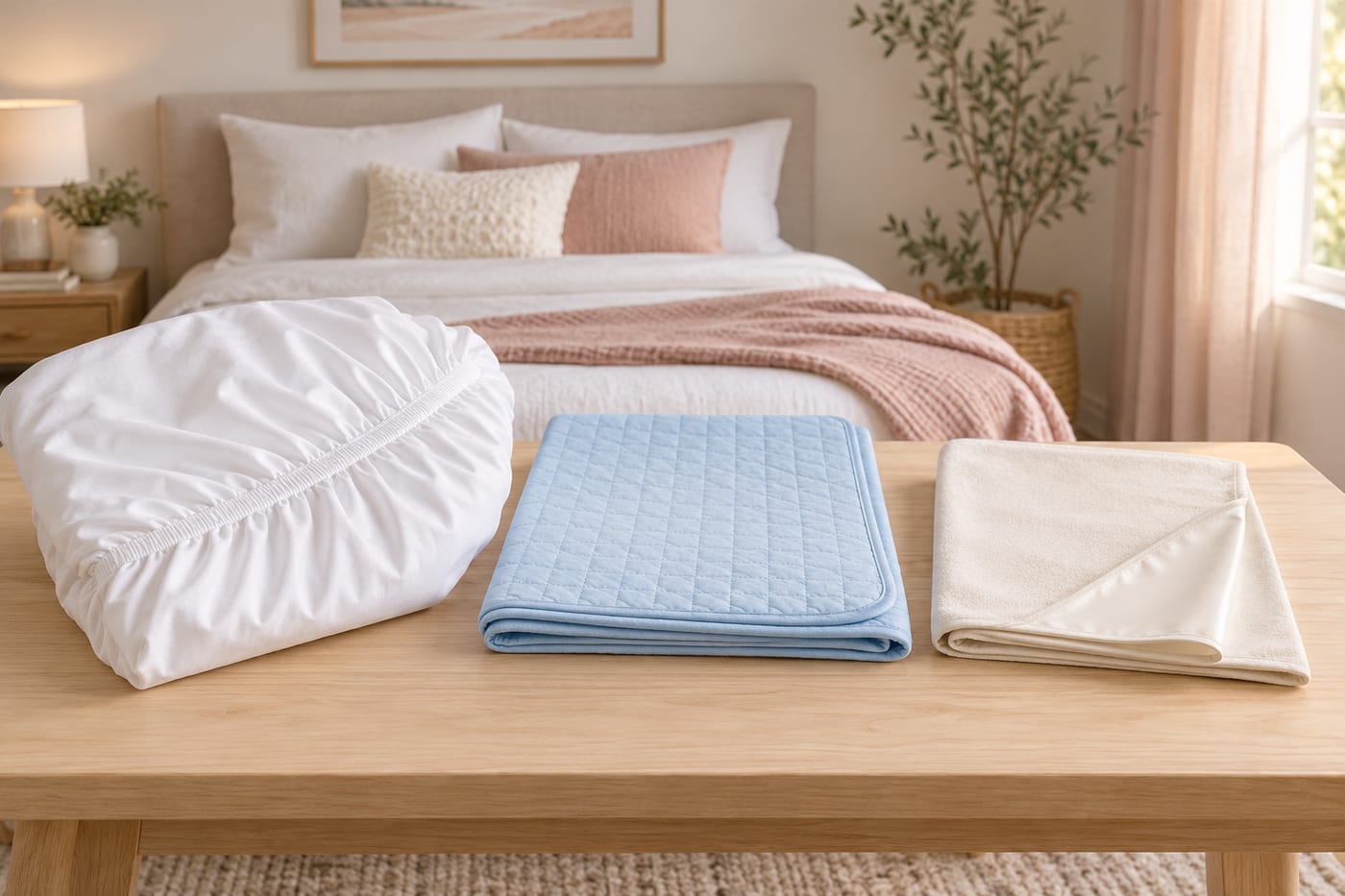
IKEA’s GRUSNARV page describes a waterproof layer, elastic construction and care directions. We use that as a specification example rather than a MyViro quietness test. Also check whether the barrier is top-only or covers other areas; a skirt does not prove waterproofing on every side. Our waterproof protector and pad guide distinguishes barriers from absorption. Selecting for quietness should preserve your required protection rather than drop it inadvertently.
How to read a manufacturer’s noise claim
Sealy’s Copper page claims that its protector does not make noise. Brolly’s page similarly describes quietness during movement. These are supplier claims for their own models rather than independent comparative results. Without a measurement method, test environment and matching conditions, there is no basis for ranking which is quieter. A large review count is not a noise measurement, and another person’s experience may concern a different size, sheet or product version.
For remote purchases, ask about a material sample, fitting directions and conditions for fit checks and returns. Retain the specification and ordered model name. If test information is supplied, establish what was actually assessed rather than just noting tested. There is no need to invent a decibel threshold when no such figure exists. A clearly attributed supplier description combined with construction information is more useful than selecting only by a promise of complete silence.
A home fit check: change one variable at a time
If instructions and product conditions allow a check, begin with correct fitting and your usual sheet. Listen during the movement that bothers you without pouring water or rubbing the barrier forcefully. Checking rustling is not a strength or permeability test. If there is a fold, arrange it as instructed and repeat the same movement. This helps establish whether fabric placement affected the experience without changing several items and losing the comparison.
Keep a short description of conditions: the same mattress, sheet and movement, and whether the protector received its instructed first treatment. The record is not a scientific test or equivalent to a shop measurement; it helps describe use at home. If washing before use is required, follow it rather than skipping it to preserve a return option. Establish conditions beforehand because inspection, use and washing may be treated differently by suppliers.
Laundering is not an improvised noise treatment
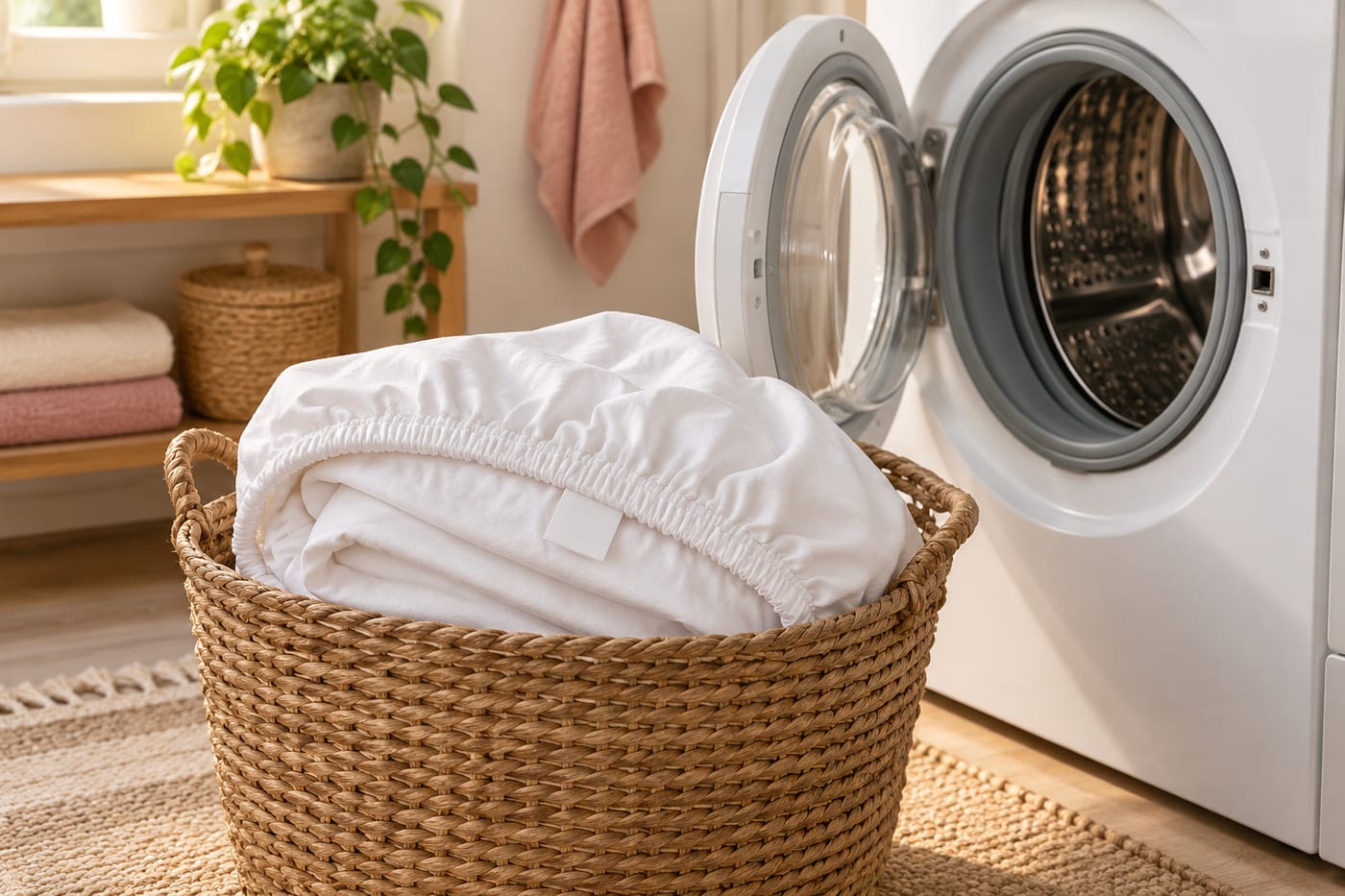
Do not use high washing heat, iron the barrier or add softener to reduce noise without permission. Care instructions concern the complete item rather than just its upper fabric. For example, TEMPUR’s cooling protector page lists model-specific directions and restrictions on substances that can damage protective layers. This demonstrates why maintenance requires an actual model specification instead of one recipe for every barrier. Another user’s online suggestion does not approve a care change.
Follow the label and inspect after complete drying. For peeling, tears or a marked change, ask the manufacturer about the item’s condition before relying on its protection. New noise alone does not prove barrier damage, but concealing a change beneath another layer is unhelpful too. Our protector washing guide explains instruction checks and drying. Recording the treatment performed helps distinguish fit issues from a change noticed after maintenance.
Warmth, softness and sound are different properties
A quiet item can feel thick, and a thin item can feel different beneath your particular sheet. Quiet should not also be turned into a cooling, moisture-management or comfort promise. Assess each property you actually need. When a material or technology brand appears, establish what it describes: upper fabric, filling, barrier or a manufacturing process. An initially cool touch is neither a noise measurement nor a promise of constant overnight feel.
If preserving the mattress feel is the goal, consider thickness and construction alongside fit. If changing the sleeping surface is the goal, that is a separate question about an appropriate topper or pad according to mattress instructions. Do not add cushioning merely to mask sound. Our topper guide explains those roles. Distinguishing needs reduces the chance of buying something that answers a marketing word while changing a property you wanted to retain.
Toppers, split mattresses and adjustable bases
Adding a topper changes height and the layer arrangement beneath the protector. Two mattresses introduce separate movement or a gap, while an adjustable base needs assessment beyond a flat position. If the sound appears when one side rises, check explicit movement compatibility against both products’ instructions. Do not stretch one shared protector between independently moving sides to hold it in place and assume the issue is solved.
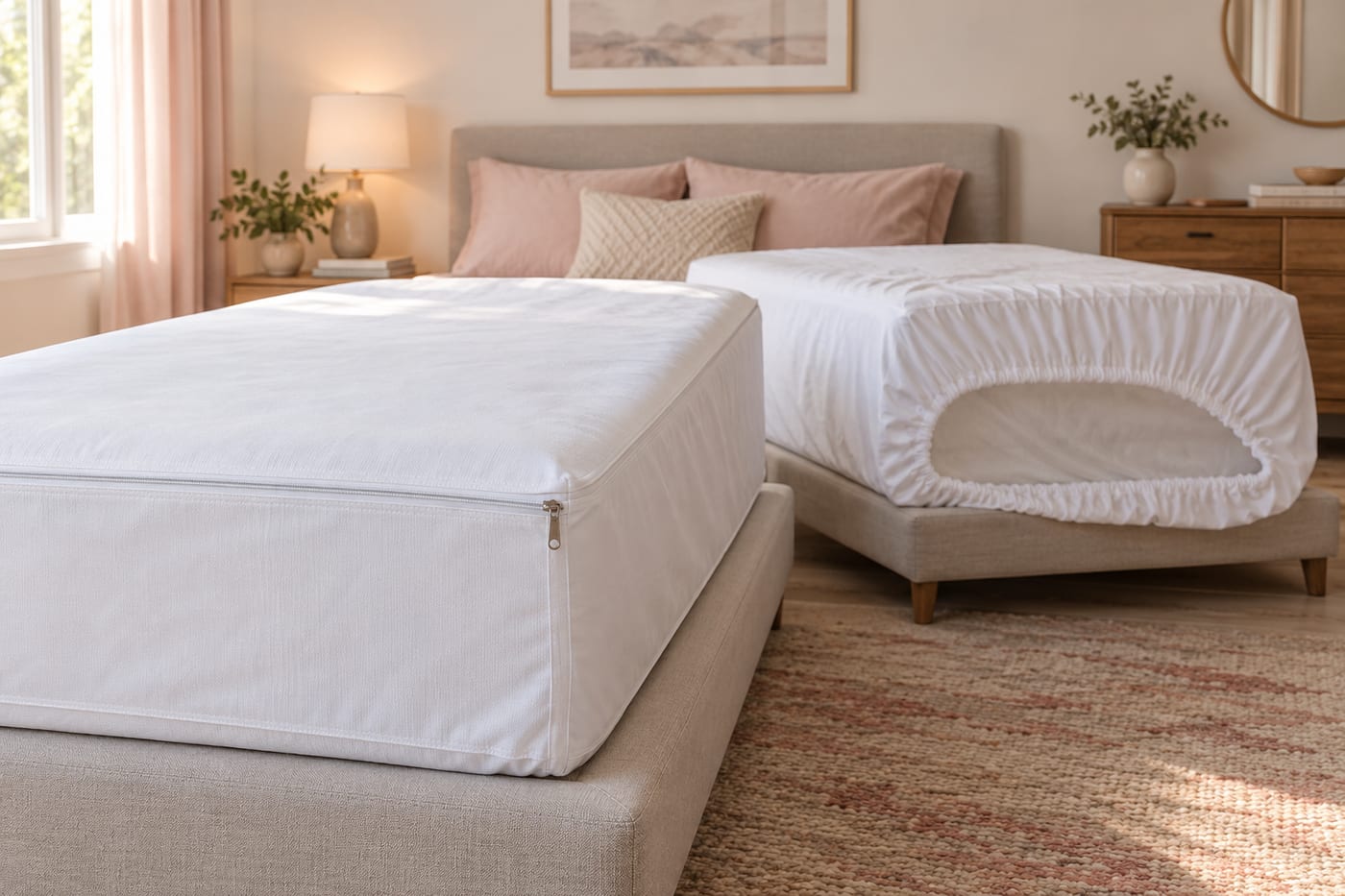
Record what the protector is intended to surround and what lies outside it. A protector beneath a topper does not protect that topper from liquid arriving above, and an enclosure around both needs sufficient combined-height fit. Our zipped and fitted guide explains removal and coverage. If inspection requires moving a heavy mattress, arrange appropriate help and do not lift it by the protector fabric. Construction compatibility comes before tightening layers in pursuit of quietness.
When to contact the seller instead of experimenting
If dimensions and instructions have been checked but the item remains uncomfortable, gather details before contacting the seller: model, size, mattress height, additional layers and when the sound occurs. State whether it happened from unpacking or only after washing. Describe a fold or moving corner without claiming a material diagnosis. This information helps the seller assess an unsuitable version, missing fitting information or a need to examine the product’s condition.
Do not continue ironing, gluing or cutting to obtain performance the item is not giving you. Such changes may damage it and complicate the enquiry. Separate a visible defect from a personal feel preference and identify both clearly. The problem does not necessarily require a thicker or more expensive protector. A structured enquiry may lead to correct fitting, a different model or attention to the bed itself according to the facts established.
Choose a quiet protector for your actual routine
Before ordering, collect the required protection, mattress dimensions and covered height, attachment style, layer composition and care directions. Add the supplier’s quietness description and permitted fit-check conditions. If the source of the current sound is unknown, investigate the bed first. This makes comparisons about an identified need and product rather than a general promise of inaudible fabric.
Retain the instructions and use the item as its model requires. Reassess fit when adding a topper or changing sheets, and follow permitted care rather than trying to alter the barrier. This guide concerns adult and older child beds; seeking quietness does not authorise another layer in an infant bed. Our crib protector guide explains the distinction and the priority of sleep guidance. An accurate need description together with suitable fit and protection supports selection without inventing a test or unverified result.
Investigate sound without altering the barrier

- Locate movement and sound
- Check fit and layers
- Compare model information
Frequently asked questions
Which protector material is silent?
No material name guarantees that. Upper fabric, barrier, padding, attachment and fit concern the complete item; assess model information.
Is every polyurethane protector quiet?
There is no such rule here. A barrier name is not a sound measurement or a description of all layers and bed use.
Can a cotton protector be waterproof?
Yes, when it includes a specified barrier; cotton may describe only the surface. Check composition and coverage without inferring quietness or waterproofing from the name.
Can softener reduce rustling?
Use it only if the model instructions permit it, not as an experiment to alter the barrier. Follow the label and discuss unusual changes with the manufacturer.
Should I buy larger to avoid tension?
Choose manufacturer-approved fit for your dimensions and height. An oversized item can fold and is not a guaranteed solution.
How can I assess noise without a laboratory?
Identify the movement and area, check fit and change one permitted variable at a time. This is a home-use impression rather than measurement or product ranking.
Have you verified Sealy or Brolly’s quietness claims?
No. The article attributes those descriptions to the model suppliers without presenting a MyViro test or independent performance comparison.
Can a quiet protector be used in an infant bed?
Quietness does not approve infant use. Follow Israeli Ministry of Health and sleep-space guidance; the dedicated guide distinguishes original components from additions.
Sources and scope
Sources checked on 12 October 2026. Manufacturer sources describe their own products and instructions; they do not establish one universal rule for all bedding and mattresses.
- Sealy Israel: Copper
Quietness is the supplier’s claim for this model, not a MyViro test or ranking against other protectors.
- Eznites: Brolly protector
Multilayer composition and supplier quietness description; neither establishes properties of every cotton fabric or barrier.
- IKEA: GRUSNARV
Example of barrier, fit and care specifications. The article does not attribute a noise test to this source.
- TEMPUR: cooling protector
Composition and model care directions illustrate treatment restrictions; not a quietness measurement or ranking source.
By MyViro.
The content explains textile characteristics and is not the result of a product test in a laboratory. How we prepare our guides